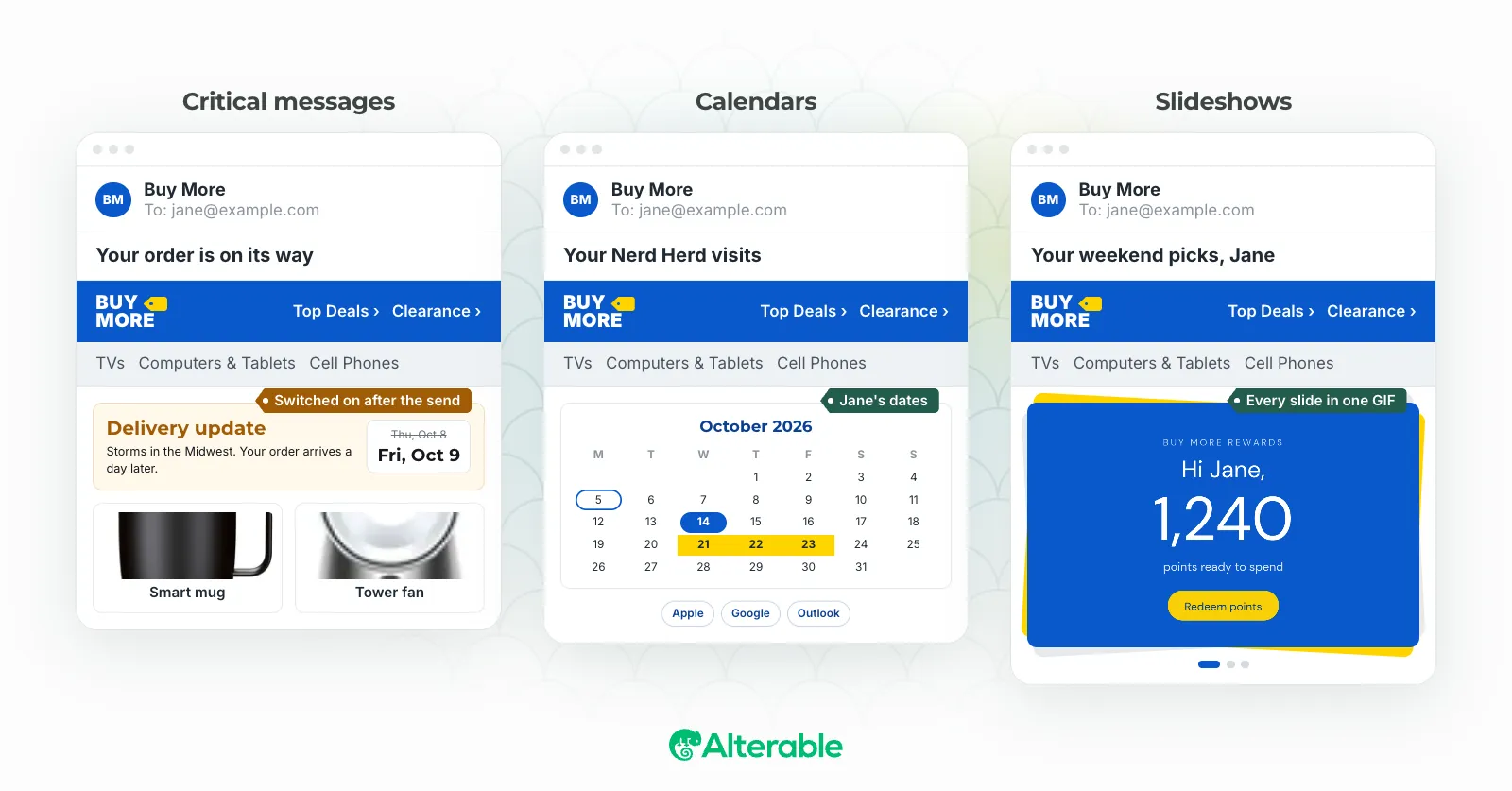
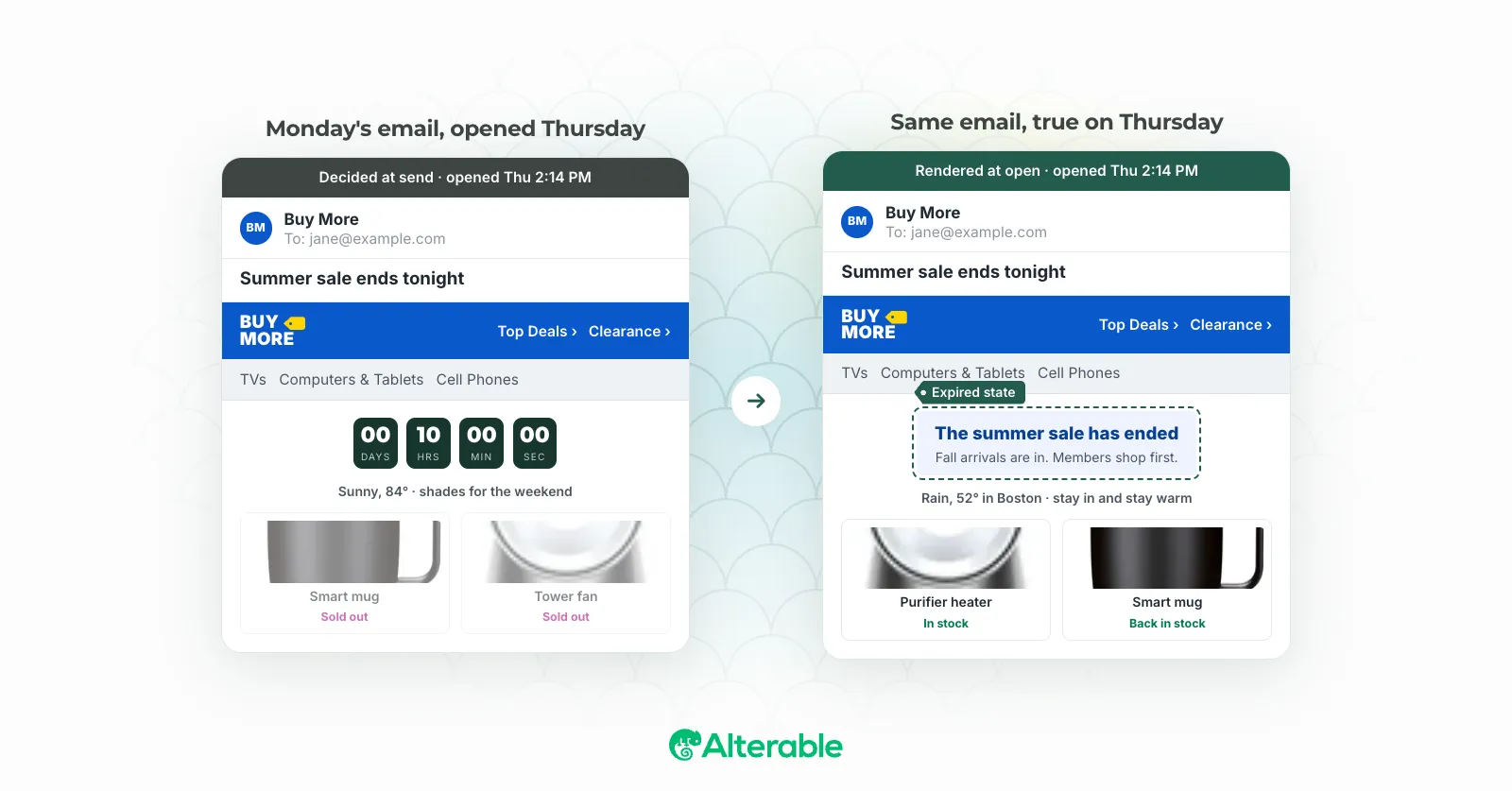
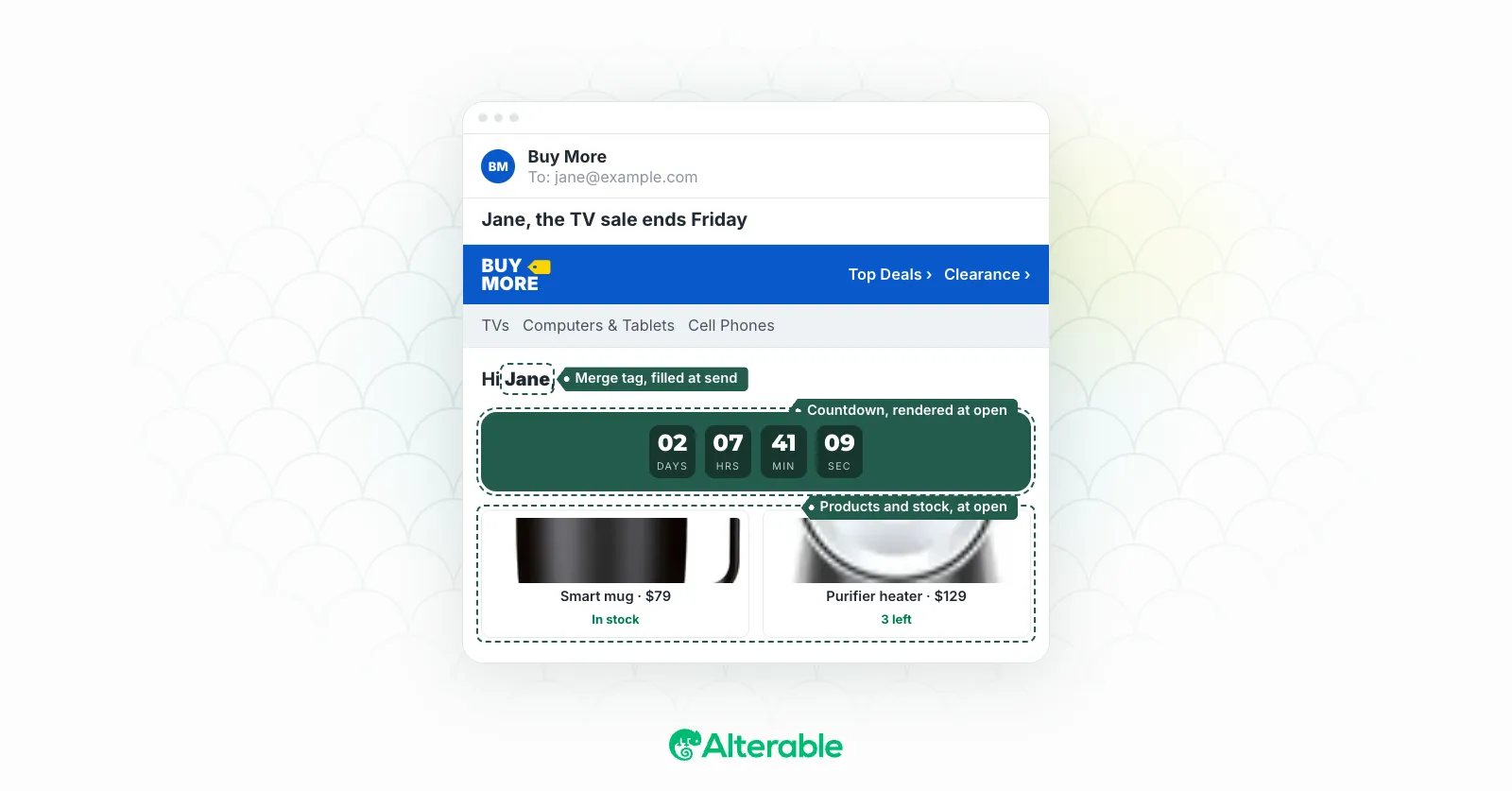
Most of the email in your inbox this morning was static. The same subject line, the same hero image and the same offer went to everyone on the list, and the sender hoped enough people would find it relevant. Some of it was personalized: your name in the greeting, maybe the product you’d looked at. A small amount was dynamic, meaning parts of it were decided at the moment you opened it rather than the moment it was sent.
Those are three different things, and the debate about personalized emails versus static emails tends to blur them. So this post separates them, using three real campaigns pulled from Inbox Archive, where we keep the actual HTML of emails as they landed. One of each kind, sent within a fortnight of each other, from brands you’ve heard of.
What a static email is
A static email is finished when you press send. Everyone receives the same HTML. Here’s Vuori announcing a new collection:
Vuori: New Arrivals: The Sunday Collection on Inbox Archive
Three products, a free-shipping threshold, the returns guarantee. Every subscriber saw the same three products in the same order. That’s not a criticism. A launch announcement is a broadcast by nature, and this one is well made: it’s the fastest kind of email to build, the easiest to test, and the right choice more often than the personalization industry likes to admit.
Its weakness is that it can’t know anything about the person reading it, and it can’t know anything that happened after it was sent. If the hoodie sells out on Friday, Saturday’s openers are still being shown it.
What personalization adds
Personalized email uses data you hold at send time. The first name is the trivial case. The useful cases are the ones that change what the reader sees. West Elm’s cart reminder is the textbook version:
West Elm: Checking in on our Portside Outdoor Adirondack Chair on Inbox Archive
The subject line names the chair. The body shows the chair, in the colour that was in the cart, with its sale price against the original. Nothing in this email would make sense to anyone but the person who left that chair behind, and that’s the point: Salesforce Marketing Cloud filled the template from the cart data when it built the message.
The engagement lift from this kind of personalization is real, and the reason is simple. A message that reflects something true about the reader is easier to care about than one that doesn’t. How large the lift is depends entirely on what you personalize. A first name in the subject line moves opens a little. The exact chair someone was about to buy moves clicks a lot. I’ve watched teams celebrate the first and never get round to the second.
The cost is data. Personalization is only as good as the fields behind it, and a wrong name or a stale recommendation lands worse than no personalization at all. Our post on personalization errors is a catalogue of what goes wrong.
What dynamic email adds on top
Dynamic, or open-time, email moves part of the decision from send time to open time. Jackery’s final-call email is the common form:
Jackery: Final Call: 24 Hours Left for Free Gift Event!💝 on Inbox Archive
The subject line says 24 hours. The countdown in the body is an image drawn by a timer service when the email is opened, so someone opening six hours after send sees eighteen hours left rather than a stale twenty-four. Klaviyo sent the message; the timer belongs to a separate tool, which is how open-time content usually arrives in an ESP. It’s the same mechanism behind a countdown timer that stays honest, a product block that reflects current stock, or a hero image that carries the weather where the reader is right now.
This closes the gap that static and personalized email share: both are frozen at send. Dynamic content is what you reach for when the time between send and open matters, which for a flash sale, a shipping cutoff or a cart hold is most of the point. Our dynamic email content post covers the mechanics.
The cost is a tool that renders at open, and a little more thought about what should still be true when the email is read late. Jackery’s timer will hit zero and stop. The Vuori email, opened a week on, will still say “new arrivals”.
Where the engagement difference really comes from
Not from the technique. From relevance. Vuori’s broadcast is relevant to anyone who likes Vuori. West Elm’s is relevant to exactly one person, which is why it works. Jackery’s is relevant for exactly as long as the offer lasts, and knows it.
So the honest verdict isn’t “personalized wins.” Each step up costs something and pays for itself only when it changes what the reader sees in a way they’d notice. A name in a greeting rarely clears that bar. The chair in the cart and the clock above a real deadline almost always do.
Picking for the campaign in front of you
If everyone should see the same thing and it will still be true tomorrow, send it static and spend the saved time on the copy, as Vuori did. If you hold data that would change the message per person, personalize, and check the data first. If the message will be wrong by the time some people read it, that’s the case for open-time content, and it’s the one where the effort shows up most clearly in the numbers.
The showdown framing is fun, but the real answer is duller: match the tool to how much the message needs to change, per person and over time. Three brands, three right answers.