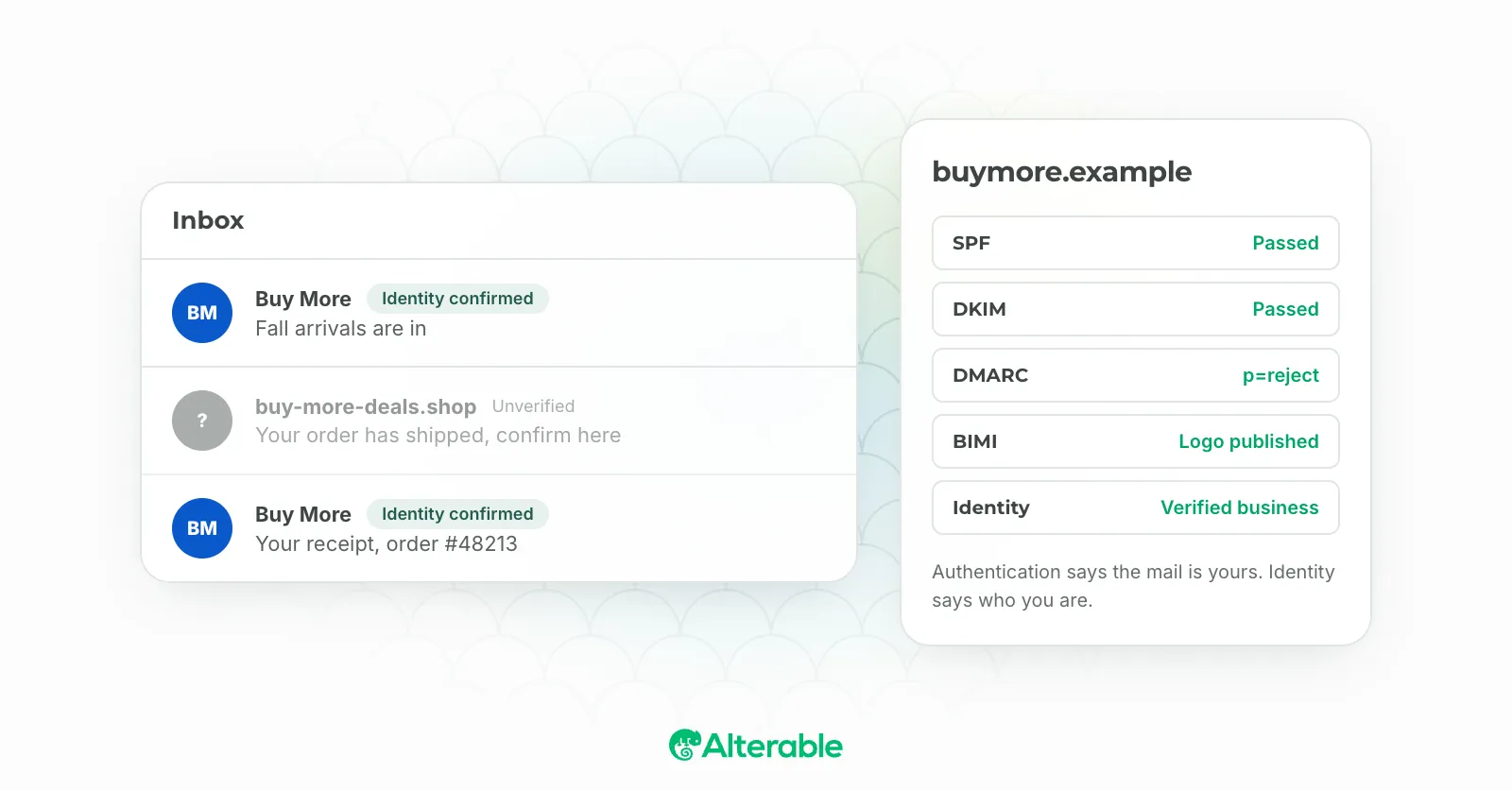
Every email deliverability guide published in the last two years ends at the same place: set up SPF, set up DKIM, publish a DMARC record, add one-click unsubscribe, keep complaints under 0.1%. Do that and you’re fine.
So here’s a campaign that does all of it, correctly, and still worries me.
We archived a Dick’s Sporting Goods promo on Inbox Archive this week. Pull up the headers and it’s close to a reference implementation:
Received-SPF: passdkim=pass header.d=e.dcsg.comdmarc=pass policy.dmarc=reject(the strictest DMARC policy there is, not thep=nonemost brands hide behind)List-Unsubscribewith both a mailto and an HTTPS endpointList-Unsubscribe-Post: List-Unsubscribe=One-Click, which is RFC 8058 done properly
They’re sending through Epsilon. This is a large team with a real ESP and someone who knows what they’re doing on the infrastructure side. If email deliverability were purely a technical problem, this brand would have solved it.
Now read the email itself.
Dick's Sporting Goods: Discover up to 50% OFF our best DEALS of the week! on Inbox Archive
What the machine actually reads
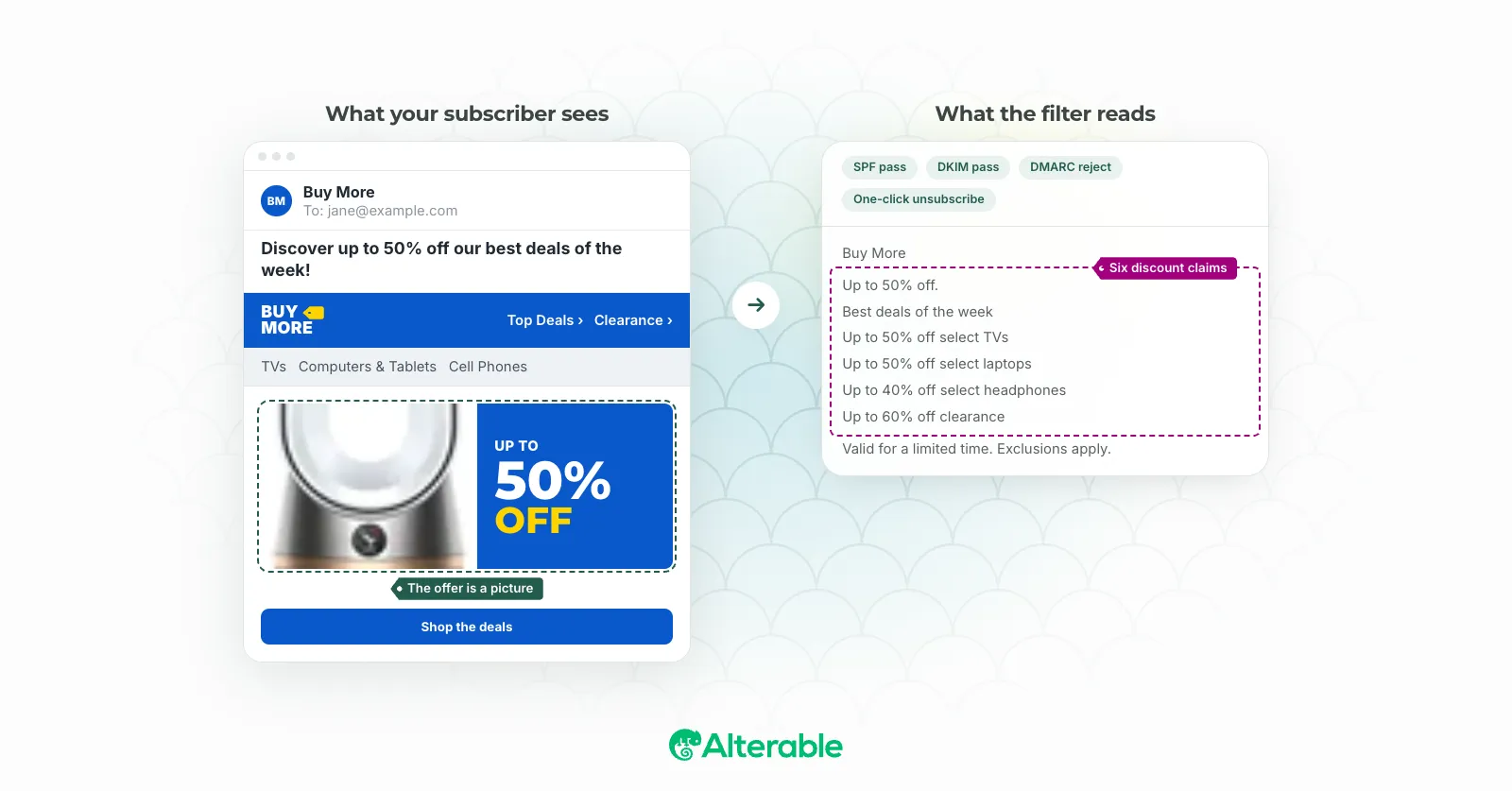
We built a “read this email as text” view into Inbox Archive mostly for accessibility reasons: screen readers, images blocked, the usual. It turned out to be the most useful diagnostic on the whole site, because it shows you the email the way software sees it rather than the way your art director sees it.
Here is that Dick’s campaign as text, condensed only slightly:
300 Points = $10 Reward. Up to 50% off. Best Deals of the Week. Up to 50% Off Select Men’s Clothing and Shoes. Up to 50% Off Select Women’s Clothing and Shoes. Up to 50% Off Select Kids’ Clothing and Shoes. Up to 40% Off Select Team Sports Equipment and Cleats. Up to 60% off select clearance scores. Valid online and in select stores for a limited time. Exclusions apply. Select clearance styles only. While quantities last. Savings off original prices. Interim markdowns may have been taken.
Six discount claims and a paragraph of legal hedging. That’s the whole semantic payload.
Visually the email is fine. Good photography, clean grid, on-brand. But the design is carrying meaning that the text layer never receives, and the text layer is what gets classified.
Now look at how often it arrives
This is the part that made me stop. On the same page, the “more from this brand” list reads:
- Sep 5: New deals added! 🙌 Shop up to 50% off during our Epic End-of-Summer Sale.
- Sep 6: These deals are EPIC! Score up to 50% off for a limited time 😎
- Sep 6: EXTRA 25% off select clearance is happening now!
- Sep 7: Labor Day deals end tonight! Don’t miss up to 50% off select clothing, shoes & more. ➡️
- Sep 7: 🌅 Shop up to 50% off our Epic End-of-Summer Sale before it’s too late 🌅
- Sep 8: 📫 Delivered: Up to 50% off this week’s DEALS
- Sep 8: Discover up to 50% OFF our best DEALS of the week!
Seven campaigns in four days. Two on the same day, three days running. Every one of them announcing up to 50% off, with capitalized shouting and emoji doing the emotional work.
And look at that Sept 8 one: 📫 Delivered:. A mailbox emoji and the word “Delivered,” which is the exact shape of a shipping notification. It isn’t one. That’s a promotional email borrowing the visual grammar of transactional mail to win an open, and it’s the kind of thing CAN-SPAM’s deceptive subject line provision exists to address.
I want to be careful here. I have no inbox placement data for Dick’s, and I’m not claiming their mail lands in spam. What I’m saying is narrower and, I think, more useful: if you built a training set of “promotional mail a filter should be suspicious of,” this pattern would be in it. Near-identical offers at high frequency, thin text, caps, emoji, and a promo dressed as a delivery notice.
Compliance stopped being the finish line
The 2024 Gmail and Yahoo requirements came with a grace period. That period is over, Microsoft has adopted a near-identical framework, and the interesting shift in 2026 is that mailbox providers are now going after senders who pass every technical check and still behave badly.
Which makes sense once you consider what’s doing the judging. Mailbox providers have leaned on machine-learning filtering for years, and the filters are more automated than ever, with fewer humans left to make your case to. Those models don’t parse your DMARC record and stop there. They read your copy, they see your sending pattern, and they compare both against millions of examples of mail people didn’t want.
Your authentication says you are who you claim to be. It says nothing about whether you’re worth reading. Increasingly, the second question is the one being scored.
So the honest version of a 2026 email deliverability checklist has a second half that nobody puts in the checklist: how often you send, whether consecutive campaigns are distinguishable from each other, and whether your text layer contains an actual message or just discount arithmetic.
The same text layer feeds your preheader now
There’s a second reason to care about this, and it arrived from an unexpected direction.
On an iPhone with Apple Intelligence enabled, the line under your subject line is no longer the email preheader you wrote. It’s a summary Apple generated by reading your email. And Apple Intelligence ignores images and alt text when it builds that summary, working only from real text.
Which text? The same stripped-down text a classifier sees.
So your text layer is now doing two jobs at once. It determines whether you get filtered, and it determines what your email preview text says. Get it wrong and you lose twice: worse placement, plus a preheader you didn’t write and can’t predict. Ask yourself what Apple would generate from six repetitions of “up to 50% off.” Whatever it is, nobody at Dick’s approved it.
Gmail’s Gemini summaries are post-open, so they don’t currently overwrite the inbox preview (Google’s rollout details are here). I wouldn’t count on that lasting. Gmail’s AI Inbox has been rolling out in beta through 2026, and it doesn’t just summarize, it sorts: suggested to-dos surface at the top, everything else gets bundled into topics to catch up on. Mail like this doesn’t get blocked in that world. It gets summarized past.
Five things worth doing this week
- Read your last campaign as text. Strip the markup and look at what remains. If it’s percentages and disclaimers, that’s your message as far as every machine in the chain is concerned. This takes five minutes.
- Line up your last ten subject lines in a column. If you can’t tell them apart at a glance, neither can a filter, and neither can your subscriber.
- Put the actual message in real HTML text, in the first couple hundred characters. Not in the hero image, not in alt text.
- Never dress a promo as a transactional message. “Delivered,” “Your order,” “Re:” and friends buy you one open and cost you trust you don’t get back.
- Use semantic markup where the medium allows. Heading tags for headings, paragraphs for body copy. Email HTML is a compromised format and you won’t get this clean, but partial structure beats a wall of nested divs.
Where this gets uncomfortable for us
Alterable renders personalized content as images at the moment of open: countdown timers, dynamic product blocks, local store maps. Images are precisely what Apple Intelligence ignores and what a text extraction throws away.
So the honest guidance, our own customers included: pair them. A countdown image reading “6 hours left” should sit beside live text saying the sale ends tonight. A dynamic product block should have a text line naming what’s in it. The rendered image persuades the human. The text survives the machine. Both readers get a whole message instead of half of one.
None of this is an argument for uglier email. Dick’s makes genuinely attractive campaigns and their infrastructure is better than most. That’s exactly why it’s a useful example: doing the technical work perfectly no longer covers you, because the thing reading your email got a lot better at reading.
Go strip one of your own campaigns to text. It’s a five-minute exercise and it tends to be a bad afternoon, in the useful way.