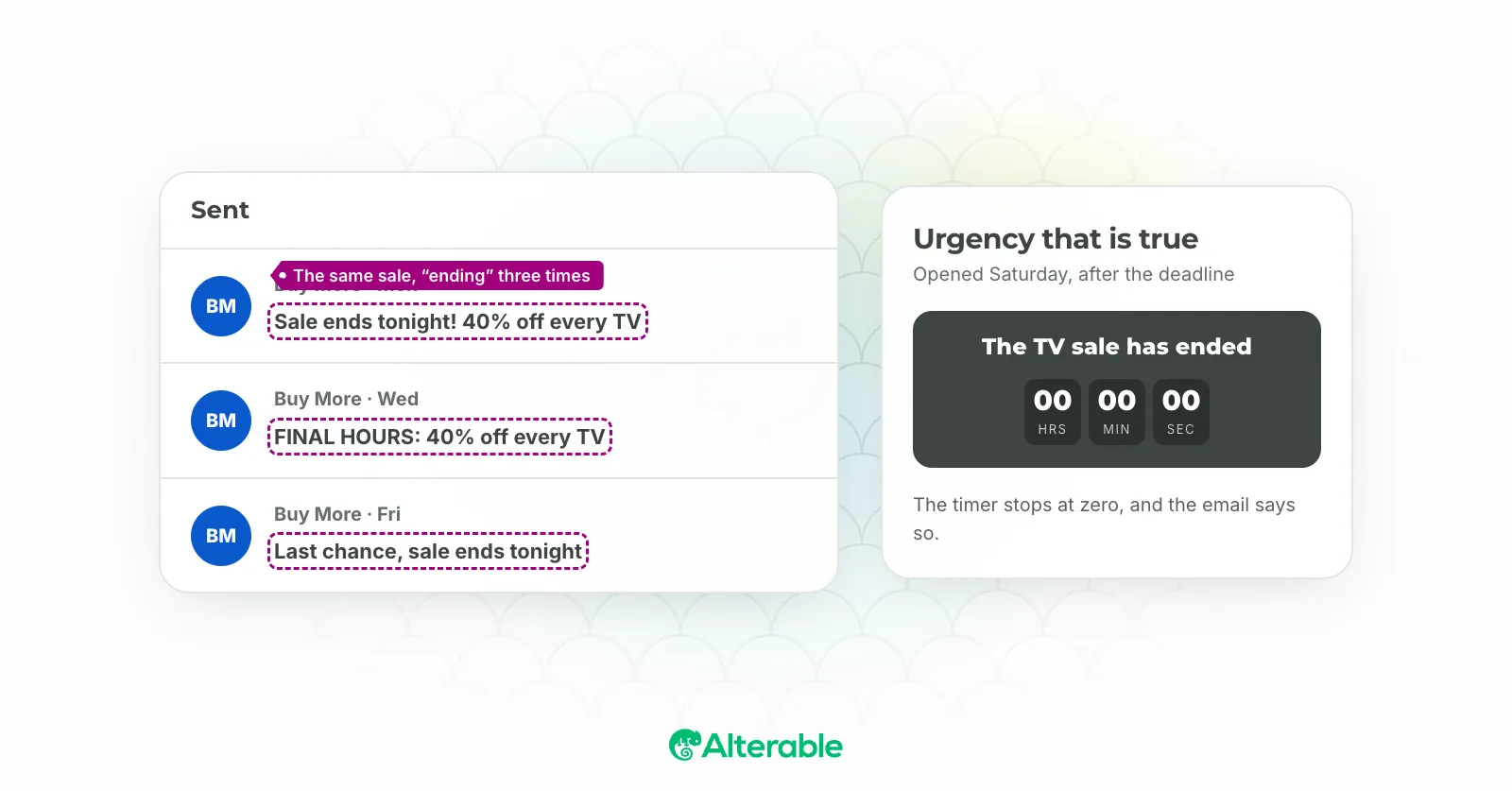
“Sale ends tonight.” “Last chance.” “Final hours.”
We’ve all sent them. I’ve written subject lines like that myself, and for twenty-five years nobody thought twice about it, because everybody knew the game. The sale ends tonight, and then it comes back on Thursday under a different name. Marketers understood the convention. Subscribers understood the convention. It was theater, and everyone had a ticket.
Then a Washington court decided the false urgency email isn’t theater. It’s a statutory violation, priced per message.
Quick note before we go further: I run an email company, not a law firm. Nothing here is legal advice. If any of this looks like it touches your program, talk to actual counsel.
What Old Navy actually did
In April 2025, the Washington Supreme Court ruled 5-4 in Brown v. Old Navy that the state’s Commercial Electronic Mail Act prohibits any false or misleading information in a commercial email subject line.
That word “any” is doing enormous work. The old reading of CEMA was narrower: a subject line was actionable if it misled you about the nature of the message, the classic spam move of disguising an ad as a personal reply. Brown blew that door open. Two plaintiffs argued that Old Navy’s emails announced promotions ending on a certain date, and then those promotions kept going. The court agreed that qualified.
The penalty at the time was $500 per email, and CEMA violations are automatically violations of Washington’s Consumer Protection Act. Multiply $500 by a Washington subscriber list, times every send in a multi-year lookback, and you get numbers that one law firm described, without much exaggeration, as potentially reaching into the trillions across the retail industry.
More than twenty class actions followed.
The law got softer in June. Your old sends didn’t.
Washington’s legislature noticed the problem it had created. Governor Ferguson signed HB 2274 in March 2026, and it took effect June 11. Two things changed, and both matter:
- Statutory damages dropped from $500 to $100 per violation. Actual damages are still available where they run higher.
- A knowledge standard got added. A plaintiff now has to show the sender acted with “actual knowledge or knowledge fairly implied on the basis of objective circumstances. ” Before, strict liability. You could be wrong innocently and still owe.
Here’s the part I’d want on a whiteboard if I were running a retail email program: the amendment applies only to actions filed on or after June 11, 2026, regardless of when the underlying sends happened. Plaintiffs’ firms understood this perfectly and rushed filings ahead of the deadline. Every suit already on file is still a $500-per-email, no-intent-required case.
So the exposure didn’t go away. It got frozen in place and then reduced going forward. Those are different things.
This isn’t only a Washington problem
The obvious response is to suppress Washington subscribers and move on. I understand the instinct. I don’t think it holds.
For one, geographic suppression assumes you know where everyone lives, and email lists are famously bad at that. People move. They sign up from work. They use a VPN.
More importantly, the federal shield that senders assumed they had is looking thinner. CAN-SPAM contains a preemption clause, and the standard defense to a state email claim has been that federal law occupies the field. That defense keeps losing. In January 2026, Judge Robart in the Western District of Washington rejected it in Ma v. Nike. In May, another court did the same in Liss v. Skechers. Both landed on the same reasoning: Congress wrote an explicit carve-out into CAN-SPAM’s preemption clause for state laws prohibiting “falsity or deception,” and a subject-line honesty statute sits squarely inside it.
Courts have now been consistently skeptical of both preemption and First Amendment challenges to CEMA. And that reasoning isn’t Washington-specific. It’s a template any state legislature can copy.
CAN-SPAM’s own penalties, meanwhile, sit at $53,088 per email, with regulators increasingly unwilling to accept “our agency sent that one” as a defense.
What a false urgency email actually looks like
The useful question isn’t “is urgency legal.” It is. The question is whether the specific claim in your subject line was true when you sent it, and stayed true.
Some rewrites:
| Risky | Safer |
|---|---|
| “Sale ends tonight!” (it doesn’t) | “Sale ends Sunday” (and it does) |
| “FINAL HOURS, 40% off” (extended twice) | “40% off through the weekend” |
| “Last chance to save” (monthly evergreen) | “Your 15% welcome offer, still available” |
| “Re: your order” (it’s a promo) | “A few things we thought you’d like” |
| “Only 3 left!” (static copy, 400 in stock) | “Only 3 left!” (pulled live from inventory) |
| “Your cart expires in 24 hours” (it never expires) | “We saved your cart for 24 hours” |
Notice what the safer column has in common. It isn’t softer. “Sale ends Sunday” is just as motivating as “sale ends tonight” if Sunday is real. The claim is simply one you could defend.
The pattern I’ve seen cause the most trouble isn’t the deliberate lie. It’s the extension. Somebody in merchandising decides Tuesday afternoon that the numbers are light and the promo should run three more days, and nobody tells the email team, whose Monday send already said the thing ends at midnight. That’s how a perfectly honest team ends up with a false urgency email in a complaint exhibit.
A quick audit you can run this week
Pull your last twelve months of sends and check:
- Any subject line with a deadline. Did the promotion actually end then? Get the merchandising calendar and compare, don’t trust memory.
- Any “last chance” or “final” language. Was it final? Or did the same offer reappear within a few weeks?
- Scarcity claims tied to numbers. “Only X left” needs to come from a live source. If it’s typed into a template, it’s a claim you can’t support.
- “Re:” and “Fwd:” prefixes. These are the original sin CEMA was written for. Remove them.
- Expiring cart or points language. If nothing actually expires, don’t say it does.
- Who can change a promo end date? If that person doesn’t have a standing line to whoever writes subject lines, you have a process gap, and process gaps are exactly what a “knowledge fairly implied” standard looks at.
That last one is the real deliverable. Everything else is cleanup.
The fix is making urgency true
The tension here is genuine, and I don’t want to pretend otherwise. Urgency works. It has always worked, and telling marketers to stop using it is both unrealistic and, frankly, bad advice. Deadlines and scarcity are legitimate information when they’re accurate.
Which means the question shifts from copywriting to infrastructure. Can your subject line and your email body know what’s actually true at the moment someone opens them?
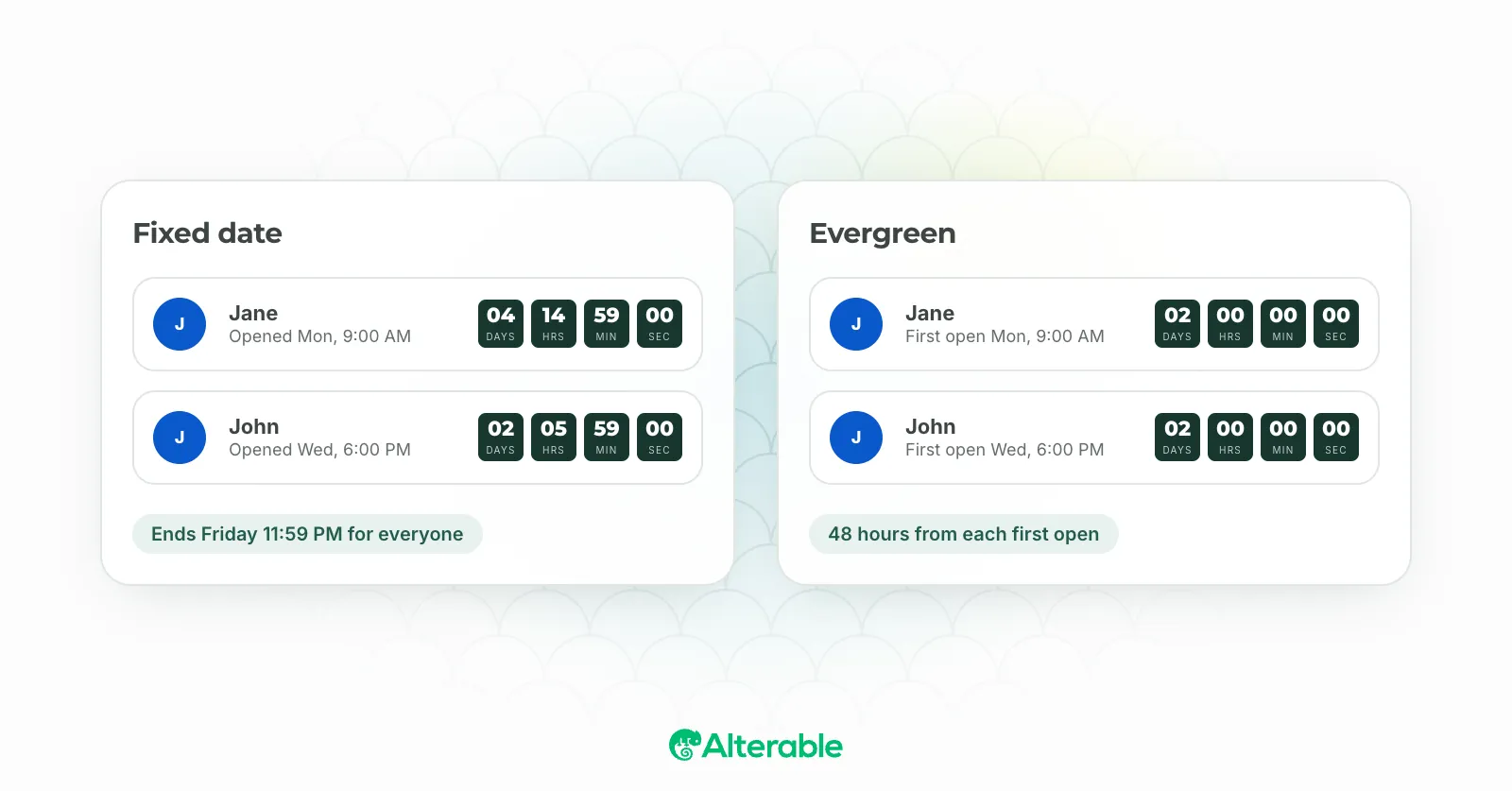
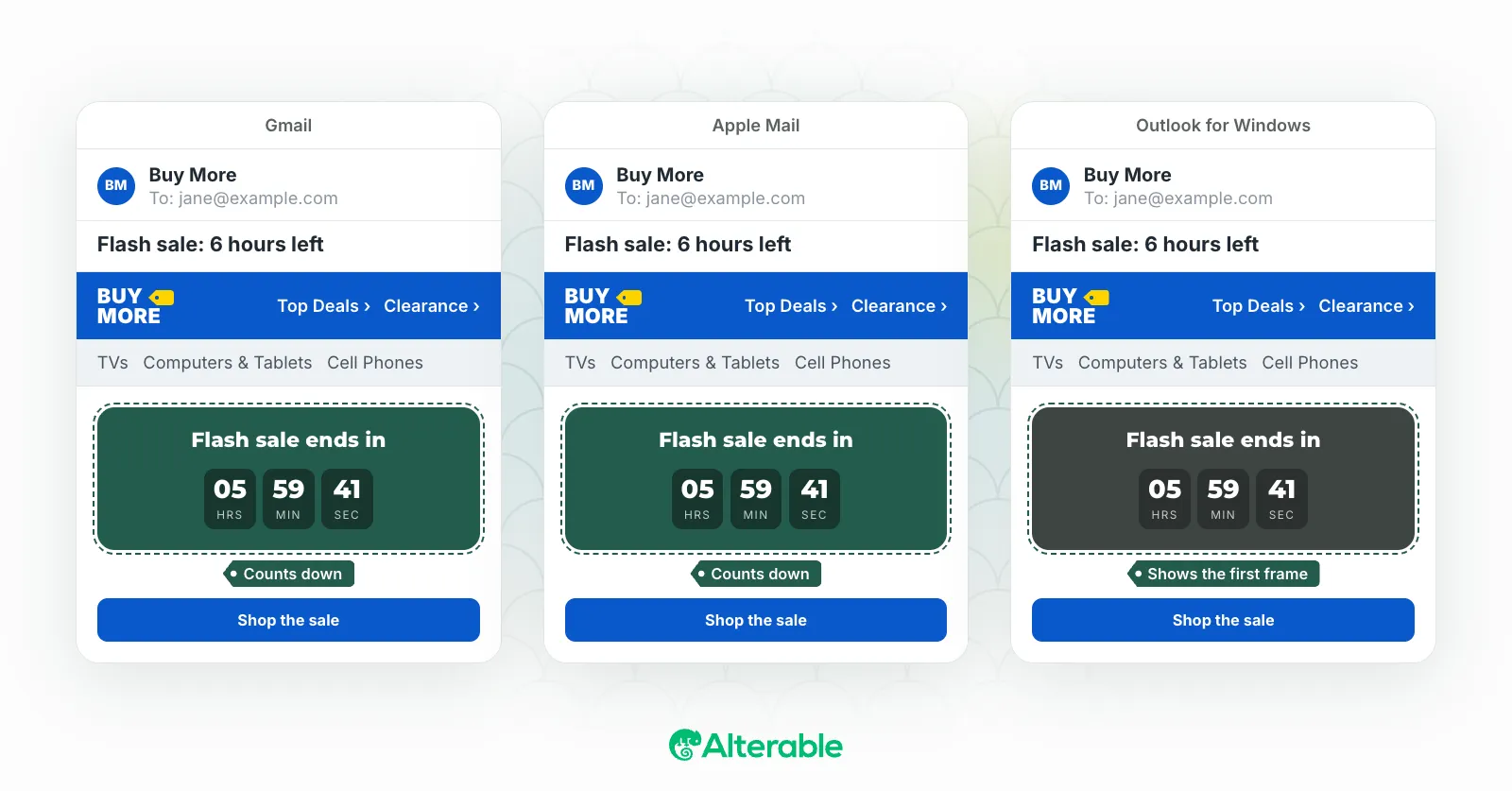
A countdown that renders from a real promotion end date can’t drift out of sync with merchandising, because it’s reading from the same source. Inventory copy that pulls a live count is either right or it renders a fallback. This is the argument for real-time content generally, and it’s a large part of why we built Alterable the way we did: content that resolves at open time is content that can’t quietly become false three days after you hit send.
Static copy makes a promise on Monday and hopes reality cooperates through Friday. Sometimes it does. Sometimes a merchandiser extends the sale, and now you’ve sent a false urgency email to everyone on your list without ever intending to.
Go pull your calendar and your last twelve months of subject lines. It’s a boring afternoon. It’s a much better afternoon than the alternative.