
For about fifteen years, the open rate was the number we all reached for first. Did the campaign land? Check the opens. Was the subject line any good? Check the opens. It was never a perfect metric, but it was a shared language, and most of the industry spoke it fluently.
That language is breaking down. And the thing breaking it is sitting in your subscribers’ pockets right now, quietly reading your emails before they do.
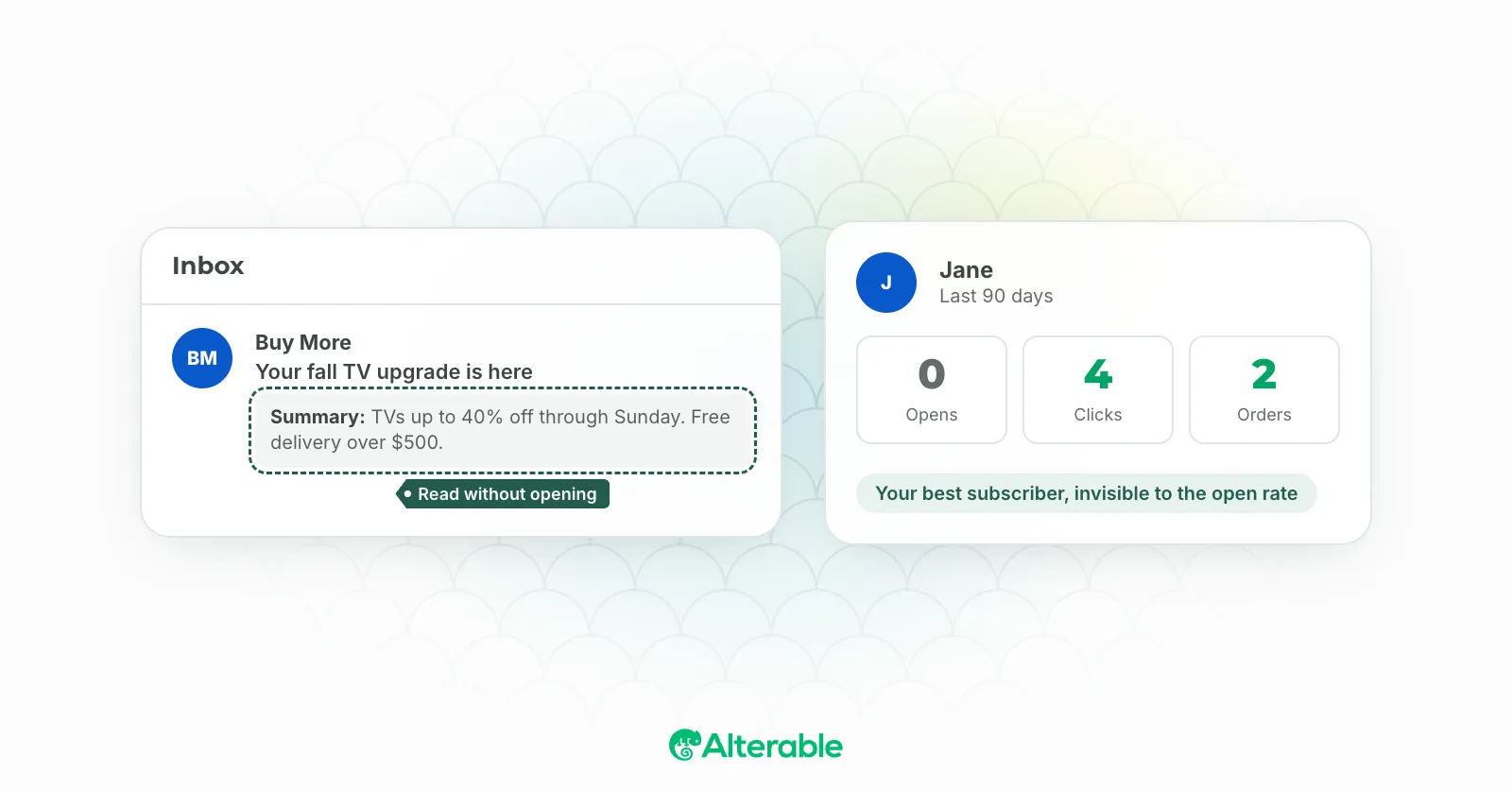
I’m talking about AI email summaries. Apple Intelligence generates them in Apple Mail, replacing your carefully written preheader with a one or two line machine summary. Gmail’s Gemini does its own version of the same trick. Your subscriber glances at the inbox, reads the gist, makes a decision, and moves on. They got the value. Your open pixel never fired.

I call that person the informed non-opener. And if you’re still judging your program by open rates alone, they’re completely invisible to you.
What AI email summaries actually change
Here’s the part most marketers haven’t fully sat with. An AI summary isn’t a preview of your email. It’s a replacement for opening it.
Think about how you scan your own inbox. You see a subject line, and now, on a lot of devices, a short summary underneath it that tells you what the message is really about. If that summary answers your question (“your order ships Thursday,” “the sale ends tonight”), why would you open? You wouldn’t. You’d act, or you’d file it away, satisfied.
That’s a genuinely new category of engagement, and it’s one your analytics can’t see. The recipient engaged with your content. They just did it one layer above the open. As Litmus put it, the summary read and the full open are now two different events, and only one of them shows up in your dashboard.
I’ve noticed this in my own habits over the past year. I read half the newsletters I’m subscribed to without ever tapping in. The summary is enough. I bet, if you’re honest, you do the same. So why do we keep assuming our subscribers behave differently?
Why the open rate was already on borrowed time
To be fair, AI email summaries didn’t kill the open rate. They just finished a job that started years ago.
Apple Mail Privacy Protection has been inflating and distorting open data since 2021, pre-loading images and firing pixels whether or not a human ever looked at the message. Anyone who’s watched their open rate mysteriously jump to 60% after a chunk of their list moved to Apple Mail already knows the number stopped meaning what it used to mean.
So we’ve had a decade of a metric getting steadily less reliable, and now a wave of AI features that let people extract value without opening at all. The open rate isn’t wrong so much as it’s incomplete. It measures a behavior that’s becoming optional.
That said, I don’t think the answer is to throw the metric out entirely. That would be its own kind of oversimplification. Opens still carry some signal, especially in aggregate and especially for trend lines. The mistake is treating them as the headline number when they’ve quietly become a footnote.
How to measure engagement when opens lie
If the open is no longer the reliable front door, you need to watch the doors that still tell you something true. A few that I lean on:
- Clicks and post-click behavior. A click is an intentional act. Nobody clicks a link by accident the way a pixel fires by accident. Pair that with what happens on the landing page, and you have a signal that AI summaries and privacy features can’t fake.
- Downstream conversions. Did the email move someone toward a purchase, a renewal, a booking? This has always been the number that pays the bills, and it’s immune to summary-reading. The informed non-opener who buys because your summary nudged them is a win, even though your open report calls them a ghost.
- Replies, unsubscribes, and complaints. For lifecycle and transactional mail especially, these tell you how people actually feel. And complaints matter more than ever, because Gmail now weighs content quality directly when it decides where you land.
None of these is a perfect one-to-one replacement for the old open rate. There isn’t one. What you’re building instead is a blend of signals that, together, tell you whether your email is doing its job.
The strategic shift hiding inside all this
Here’s the insight I keep coming back to. If an AI is going to summarize your email before your subscriber reads it, the summary is now part of your creative.
Every email you send is being compressed into a sentence or two by a model you don’t control, and that compression is what a lot of your audience actually sees. Which means the substance has to survive the squeeze. A promo that’s all image and no structured text gives the AI nothing useful to summarize. A message with a clear, front-loaded point gets summarized well, and the summary does your selling for you.
So the craft shifts. Lead with the real information. Put the value where a machine can find it. Write the first line as if it’s the only line that will be read, because for a growing share of your list, it is.
This is also where relevance stops being a nice-to-have. A generic batch-and-blast gets summarized into generic mush. A message tailored to what this specific person cares about produces a summary that’s tailored too, and that’s the version that earns a click instead of a shrug. The more specific the input, the more useful the AI-generated summary becomes to the reader.
Where this leaves you
The informed non-opener isn’t a problem to solve. They’re a signal that our measurement caught up to reality a few years late. People have always skimmed, decided, and moved on. AI email summaries just made that behavior visible in the aggregate, even as they hid it from our open reports.
So stop mourning the open rate, and start asking a better question: is my email delivering value that survives being compressed into two lines by a machine? If the answer is yes, the opens you can’t see are working for you anyway.
That’s the shift worth making this quarter. It means writing emails that read well at a glance and reward the click, and personalizing them so the summary a subscriber sees actually speaks to them. Real-time personalization is a big part of how we think about that at Alterable: if the AI is going to summarize your email, you want the most relevant possible version of it reaching each person in the first place. Give the machine something worth summarizing, and the informed non-opener becomes your quietest, most valuable reader.


