
What Is an Email Engagement Score (And Why It Matters More Than Open Rate)
For years, open rate was the metric email marketers lived and died by. High opens meant the subject line worked, the list was healthy, the program was running well. Then Apple launched Mail Privacy Protection in September 2021, and open rate stopped meaning what it used to.
MPP pre-fetches email content on Apple’s servers when a message is delivered, triggering a pixel open regardless of whether the subscriber ever actually read the email. For senders with large audiences on Apple Mail, which covers a substantial share of email clients, reported open rates inflated overnight. I’ve seen programs where open rates jumped 20 to 30 percentage points after MPP rolled out. The numbers looked great. The underlying engagement hadn’t changed at all.
This is why email engagement scores matter, and why they matter more now than they did before. A well-constructed engagement score looks past opens at the signals that are both harder to fake and more directly connected to what you actually care about.
What an engagement score actually is
Here’s something the industry doesn’t say clearly enough: there’s no universal email engagement score. Every major ESP calculates it differently, and many brands build their own. What they share is the basic intent: combine multiple behavioral signals into a single number that reflects how active and valuable a given subscriber is.
The signals that typically feed into engagement scores include clicks (much harder to inflate artificially than opens), conversions, reply rates where trackable, forward rates, and negative signals like unsubscribes and spam complaints. Some scoring models also factor in recency and frequency: not just whether someone has ever clicked, but how recently and how consistently.
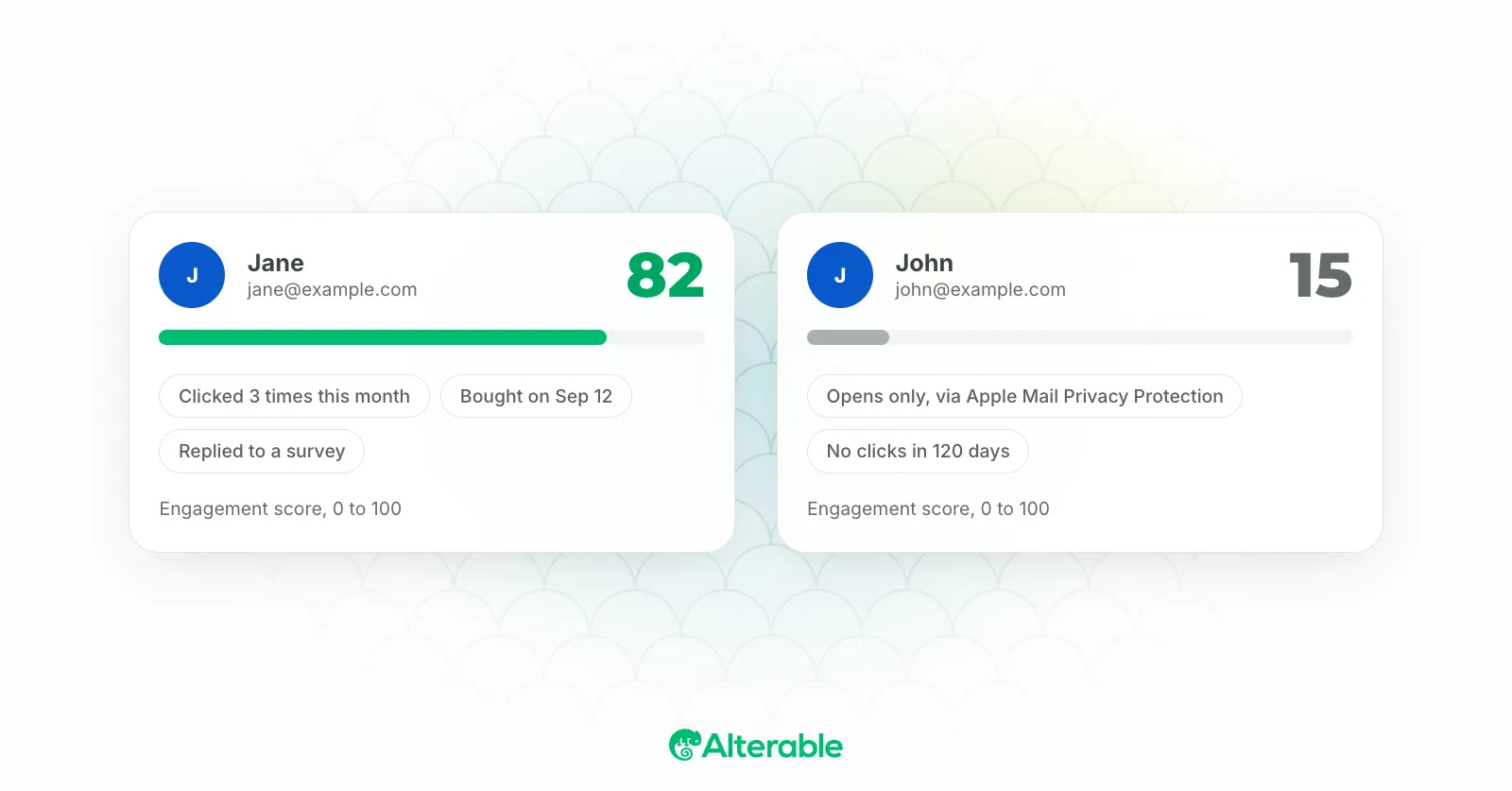
What you get is a number that approximates the relationship between your brand and each subscriber. A score of 80 means someone is actively engaging across multiple dimensions. A score of 15 means they’re technically on your list and not much else.
The practical value of that number depends entirely on what you do with it.
Why this connects directly to deliverability
The reason engagement scoring isn’t just a vanity exercise is that inbox providers, particularly Gmail, use engagement signals to determine where your emails land. Gmail’s filtering is not purely content-based. It’s behavioral: if your emails consistently get opened, clicked, and replied to, Gmail learns your domain sends wanted mail. If they consistently get ignored or deleted unread, Gmail starts routing you to the Promotions tab or spam, regardless of your content.
This creates a feedback loop that’s easy to miss until it’s already working against you. Low engagement leads to worse inbox placement. Worse inbox placement leads to lower engagement. By the time open rates and click rates are visibly declining, the deliverability problem is often already established.
Engagement scoring is how you stay ahead of that loop. By identifying low-engagement subscribers before they drag down your overall metrics, you can make decisions about suppression, re-engagement, or removal before the damage compounds.
The post-MPP approach to scoring
Given that opens are unreliable for a significant portion of most email audiences, a current engagement score should weight clicks heavily. A click is an intentional action. It requires the subscriber to actually open the email, read enough to be interested, and physically tap or click a link. It’s the most honest behavioral signal in the stack.
Conversions are even stronger, but harder to track at scale because they require passing purchase or action data back from your site or platform. Worth setting up if you haven’t, but clicks are the practical working proxy for most programs.
Recency matters more than some scoring models acknowledge. A subscriber who clicked three times last month is more valuable than one who clicked ten times two years ago and nothing since. The standard window I’ve seen work well is 90 days for “engaged” classification: if someone has clicked at least once in the last 90 days, they’re active. Beyond that, engagement status starts to decay.
Negative signals deserve their own weight. An unsubscribe is a neutral outcome: the subscriber made a clean exit. A spam complaint is a significant negative signal, both for your score and your sender reputation directly. If a segment generates complaint rates above 0.1%, that segment needs attention before your next send.
Using the score operationally
The three main uses of engagement scoring are suppression, re-engagement, and segmentation.
Suppression is the counterintuitive one. Sending to your full list every time feels like maximizing reach, but emailing highly disengaged subscribers actively hurts deliverability. Before a major campaign, suppressing subscribers who haven’t engaged in six months (or twelve months for lower-frequency senders) improves the engagement rate on that send, which improves your domain’s standing with inbox providers. You’re sending to fewer people, but more of those people will receive and act on it.
Re-engagement campaigns target the disengaged tier before you remove them. The goal is to either win back genuine interest or confirm the relationship is over. A good re-engagement sequence acknowledges the silence directly (something like “we haven’t heard from you in a while”), offers something worth clicking on, and gives the subscriber an easy way to indicate their preference. Those who don’t engage over the sequence get removed. This sounds like losing subscribers. It’s actually cleaning the foundation your deliverability sits on.
Segmentation by engagement tier shapes everything else you send. Highly engaged subscribers are the right audience for new product announcements, referral asks, and loyalty offers. They’ve demonstrated they want to hear from you. Mid-engagement subscribers need content that earns continued interest. Low-engagement subscribers need different messaging altogether, often focused on reminding them why they signed up in the first place.
Dynamic content makes this easier to execute. With Alterable, you can serve different content blocks to different engagement tiers within the same campaign: your most engaged subscribers see a product recommendation tailored to their history, while less engaged subscribers see a re-engagement-focused message with a clear reason to click. One send, multiple versions, each calibrated to where the subscriber actually is.
The number is only as useful as what you do with it
Engagement scoring can become a reporting exercise that nobody acts on, and that’s how it stays useless. The value shows up when it drives actual decisions: who gets suppressed before a major send, who enters a re-engagement flow, who gets early access to a new product because they’ve consistently clicked on that category.
The underlying principle is that a smaller, genuinely engaged list performs better by every measure than a large list that mostly ignores you. That’s not intuitive when you’re watching subscriber counts. But the deliverability data, and eventually the revenue data, makes it obvious.


