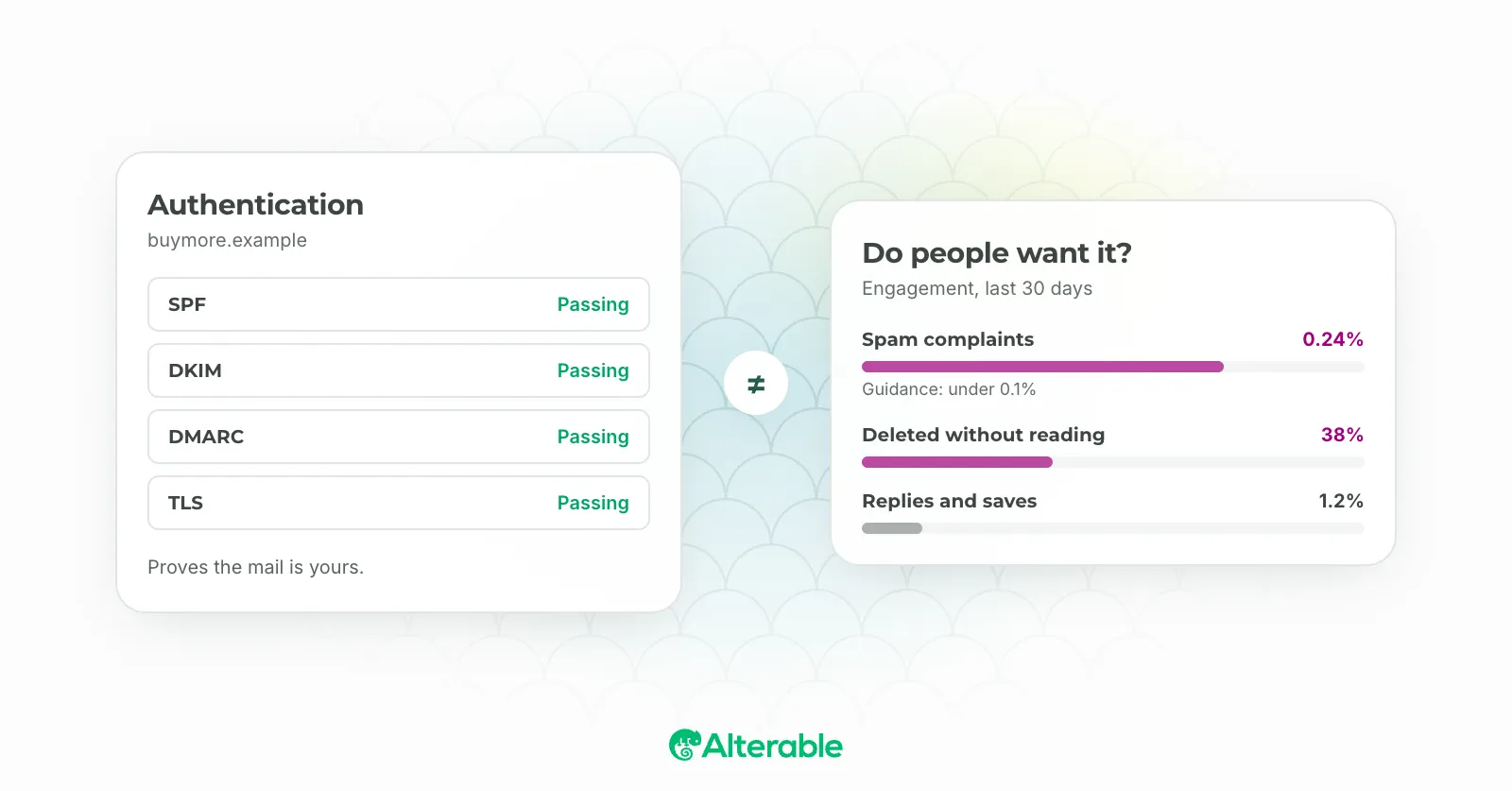
Here’s a thing that trips up a lot of email marketers: you can write a perfectly legitimate promotional email, use a handful of words that spam filters associate with bad actors, and watch your deliverability quietly suffer. Not because your email is spam, but because it looks like spam.
Spam trigger words are phrases that email filters and mailbox providers have learned to treat as red flags. They show up disproportionately in emails that people mark as spam, which means filters have been trained to be suspicious of them. Use too many of them together, especially alongside other signals like all-caps text, excessive punctuation, or a damaged sender reputation, and you’re pushing your email toward the junk folder.
Before getting into the list, one important caveat.
How Spam Filters Actually Work (And Why This List Still Matters)
Modern spam filtering at providers like Gmail has moved well beyond simple keyword matching. Gmail’s filters are primarily driven by engagement signals: whether people open your emails, click them, reply, or mark them as spam. A single trigger word won’t get you filtered if your sender reputation is strong and your list is engaged.
That said, this list still matters for three reasons.
First, not all email clients are Gmail. Corporate and B2B inboxes often run on Microsoft Exchange or Outlook, which use more aggressive content-based filtering. If you’re sending to a business audience, content scanning is more of a real factor.
Second, most ESPs run their own spam checks before you send. Trigger words will surface as warnings in tools like Postmark’s spam score checker, Mail Tester, and the built-in checkers in most major platforms. Clearing those warnings is good hygiene.
Third, and most practically: these words tend to correlate with low-quality copy. If your subject line reads “Earn extra cash, guaranteed income, act now!”, the problem isn’t just that filters flag it. It’s that your subscribers will too. The trust damage happens before the open.
The Categories Worth Understanding
Spam trigger words cluster into a few predictable patterns. Knowing which category a word falls into helps you understand why it’s a problem and how to rewrite around it.
Financial Promises and Money Language
This category gets flagged because it mirrors the language of scams and get-rich-quick schemes. Most filters are tuned to catch it aggressively.
Words and phrases to avoid: 100% free, additional income, be your own boss, big bucks, cash bonus, double your income, earn extra cash, earn money fast, extra income, financial freedom, free gift, free money, get paid, get rich, guaranteed income, make money, million dollars, pennies a day, potential earnings, pure profit, risk-free returns.
The irony is that many legitimate businesses use these phrases naturally. If you’re running a genuine promotion, the fix is usually precision: “30% off all annual plans until Friday” is both more specific and less suspicious than “save big money today.”
Urgency and Pressure Tactics
Urgency isn’t inherently spam-coded. A real deadline is a legitimate reason to email. The problem is words that signal manufactured pressure with no substance behind them.
Watch out for: Act now, apply now, call now, don’t miss out, expires today, get it now, hurry, limited time offer, now or never, offer expires, once in a lifetime, order now, this won’t last, time is running out, urgent, what are you waiting for, while supplies last.
If you have a real deadline, state it plainly: “This offer closes Thursday at midnight.” That’s specific and honest. “Act now before it’s too late” is neither.
Suspicious Claims and Winner Language
Filters are trained on decades of prize-draw scams and phishing emails. This category is heavily weighted in most filtering algorithms.
Phrases to avoid: Congratulations, dear friend, exclusive deal, you are a winner, you have been selected, you’ve been chosen, you’ve won, selected for you, special offer just for you.
Personalization is still powerful, but it lands better when it’s grounded in real data (“Based on what you’ve been reading” or “You might like this”) rather than manufactured exclusivity language.
Deceptive and Self-Referential Language
A telling signal: any phrase that draws attention to whether the email is spam. Legitimate senders don’t need to say “this is not spam.” The defensive framing raises more suspicion than it deflects.
Avoid: This is not spam, not junk, this isn’t a scam, we hate spam too, confidential, no obligation, no strings attached, no hidden fees, no tricks, no catch, risk-free, 100% satisfied.
The same goes for phrases that reference email mechanics in a suspicious way: bulk email, direct email, mass email, email marketing (in the email body itself), removal.
Clickbait and Shallow CTAs
This category affects engagement more than filtering, but weak CTAs also correlate with low click rates, which is a signal in itself.
Watch out for: Click here, click below, click now, open immediately, see for yourself, don’t delete, please read, visit our website, order now.
Better CTAs are specific about the action and the payoff: “See the full breakdown” or “Get your free report” tell the reader what they’re clicking toward. “Click here” tells them nothing.
The Miscellaneous Category (Legalese, Jargon, and Bad Associations)
This is the catch-all: phrases that have been burned by their association with spam or scam emails over the years.
Worth avoiding: As seen on, bargain, beneficiary, billing, cards accepted, certified, clearance, compare rates, debt, discount (in certain contexts), fantastic, free trial, income, investment, jackpot, loans, luxury, marketing solutions, mortgage, opt-in, pre-approved, prize, quote, refinance, warranty, work from home.
Some of these (“discount,” “free trial,” “investment”) are perfectly reasonable words in context. The signal isn’t any single word but patterns of them together.
Rewrites Worth Borrowing
A few direct comparisons to make this concrete:
| Instead of… | Try… |
|---|---|
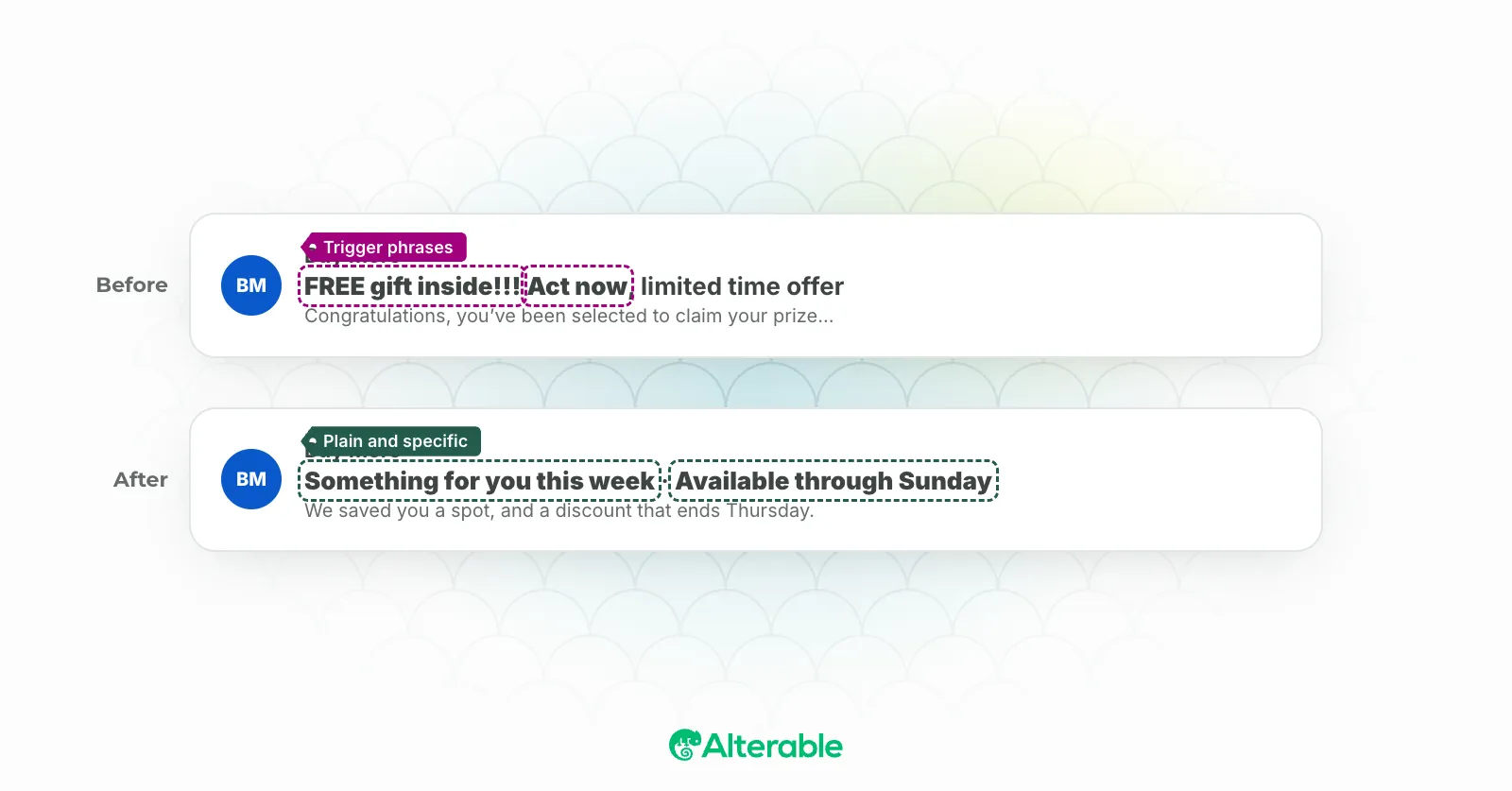
| “Free gift inside!” | “Something for you this week” |
| “Act now, limited time offer!” | “Available through Sunday” |
| “Earn extra income from home” | “How our customers are saving 6 hours a week” |
| “Congratulations, you’ve been selected” | “We saved a spot for you” |
| “Click here to claim your prize” | “Claim your discount before Thursday” |
| “Guaranteed results or your money back” | “If it doesn’t work for you, we’ll refund you. Full stop.” |
The pattern is consistent: specificity and plainness outperform hype and vague urgency, both with filters and with readers.
A Few Practical Steps
Run a spam check before every campaign. Alterable’s free email spam checker scans your content for trigger words and flags issues before you send. For a broader deliverability score, Mail Tester and Postmark’s spam checker are also worth keeping in your workflow. Takes two minutes and has saved many campaigns from unnecessary friction.
Pay more attention to your sender reputation than your word choice. A strong reputation, built through consistent engagement, clean list hygiene, and low complaint rates, gives you more latitude with individual words. A damaged reputation means the same words carry more weight against you. Checking your deliverability before sending is worth building into your workflow.
Watch the patterns, not just the words. One use of “free” in a well-coded email with strong engagement metrics is unlikely to cause problems. Five trigger words in the subject line alone, combined with all-caps and three exclamation points, is a different story. Filters look at the whole picture.
Audit your templates periodically. Trigger word habits accumulate quietly. A template that was fine when you built it two years ago may have picked up a few phrases over time that are worth cleaning out.
The goal isn’t to write emails that feel sanitized or robotic. It’s to write emails that are specific, honest, and genuinely useful to the person receiving them. That tends to align with avoiding trigger words as a side effect, rather than the other way around.