Google processes somewhere in the neighborhood of 1.5 billion active Gmail accounts. That’s a lot of inboxes, and a lot of filtering decisions happening before your email ever lands in front of someone. If Gmail doesn’t trust you as a sender, a good chunk of your list may simply never see what you send.
A Gmail reputation check isn’t a one-time diagnostic. It’s an ongoing practice. And it starts with understanding that Gmail evaluates you from several directions at once: how you authenticate your mail, how your subscribers behave when they receive it, and whether your sending patterns look like someone who knows what they’re doing or someone trying to sneak past the filters.
Here’s how to assess where you stand, fix what’s broken, and build something that holds up over time.
Start with Google Postmaster Tools
If you’re not using Google Postmaster Tools yet, that’s the first thing to fix. It’s free, it’s authoritative, and it gives you data directly from Google about how they see your sending domain. No third-party inference required.
Setup takes about ten minutes. You verify your sending domain by adding a TXT record to your DNS, and within a few days you’ll have access to dashboards covering:
- Domain Reputation: Google’s own rating of your domain, on a scale of High, Medium, Low, or Bad.
- IP Reputation: How Google views the IP addresses your mail is coming from.
- Spam Rate: The percentage of your emails that Gmail users are marking as spam, calculated against DKIM-authenticated volume.
- Delivery Errors: Specific error codes showing where mail is being rejected or deferred.
- Authentication: Whether your SPF, DKIM, and DMARC are passing correctly.
I’ve seen senders who were convinced they had a content problem, only to open up Postmaster Tools and find their spam rate had been quietly climbing for three weeks. The data was there. They just hadn’t looked.
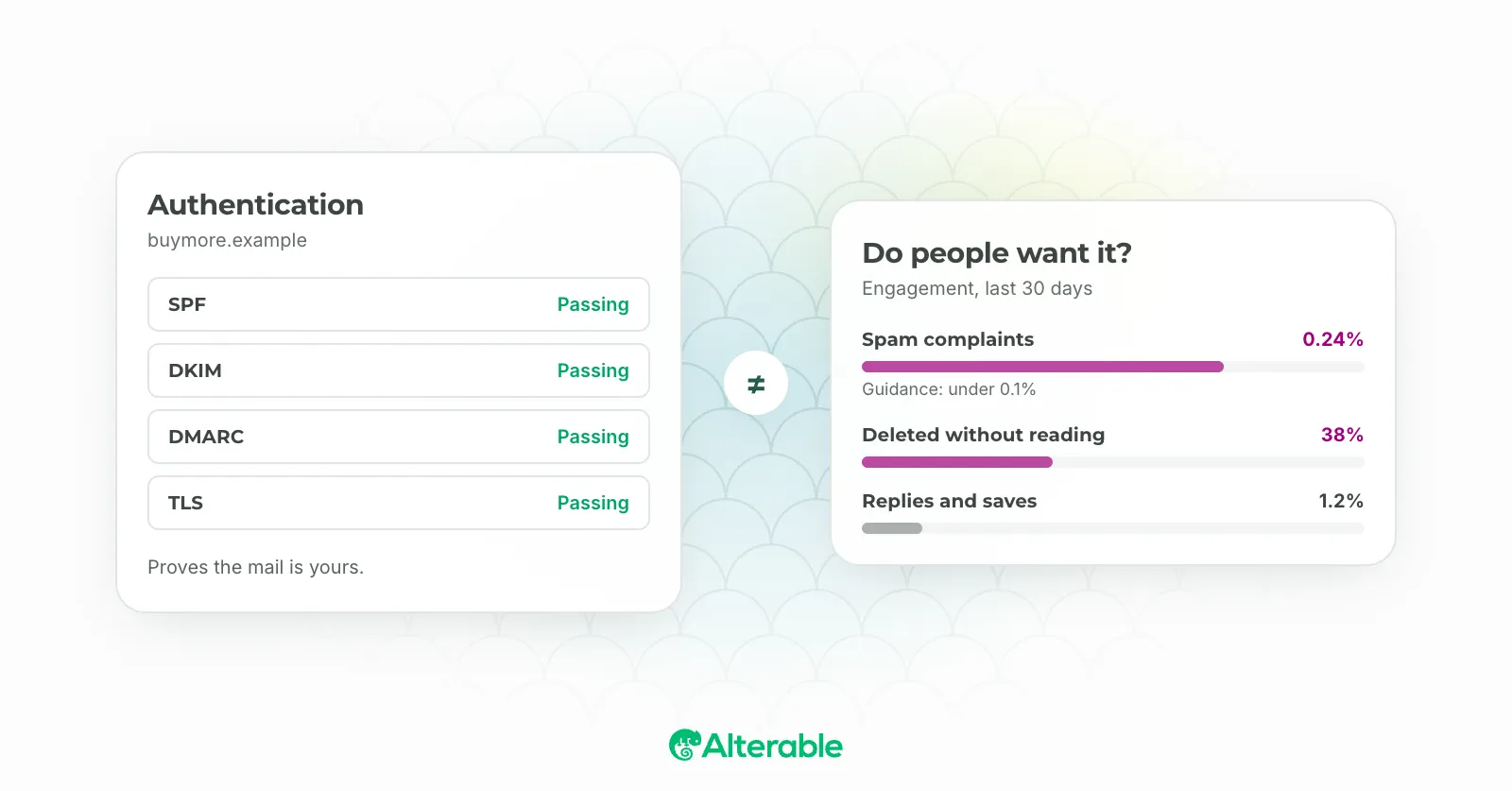
The most important number to watch is your Spam Rate. Google’s 2024 sender guidelines put the threshold at 0.1% for concern and 0.3% as the point where they start taking action. Those are lower than most people expect.
Set Up Proper Email Authentication First
Before you can meaningfully improve your Gmail reputation, you need to set up proper email authentication. Without it, Gmail has no reliable way to confirm that mail from your domain is actually from you, and senders that can’t be verified don’t get the benefit of the doubt.
The three protocols you need are SPF, DKIM, and DMARC. They work together, and all three matter.
SPF (Sender Policy Framework) tells receiving mail servers which IP addresses are authorized to send mail from your domain. It’s a DNS TXT record that essentially says: “Mail coming from my domain should only come from these sources.” If you’re sending through an ESP, they’ll usually provide the record to add.
DKIM (DomainKeys Identified Mail) adds a cryptographic signature to your outgoing emails. The receiving server checks that signature against a public key published in your DNS. If it matches, the email hasn’t been tampered with in transit and genuinely originated from an authorized source. Most ESPs handle DKIM signing for you, but you need to add the DKIM key they provide to your DNS.
DMARC (Domain-based Message Authentication, Reporting, and Conformance) ties the two together. It tells Gmail what to do when an email fails SPF or DKIM checks (quarantine it, reject it, or do nothing with p=none) and gives you a reporting mechanism so you can see what’s passing and what isn’t.
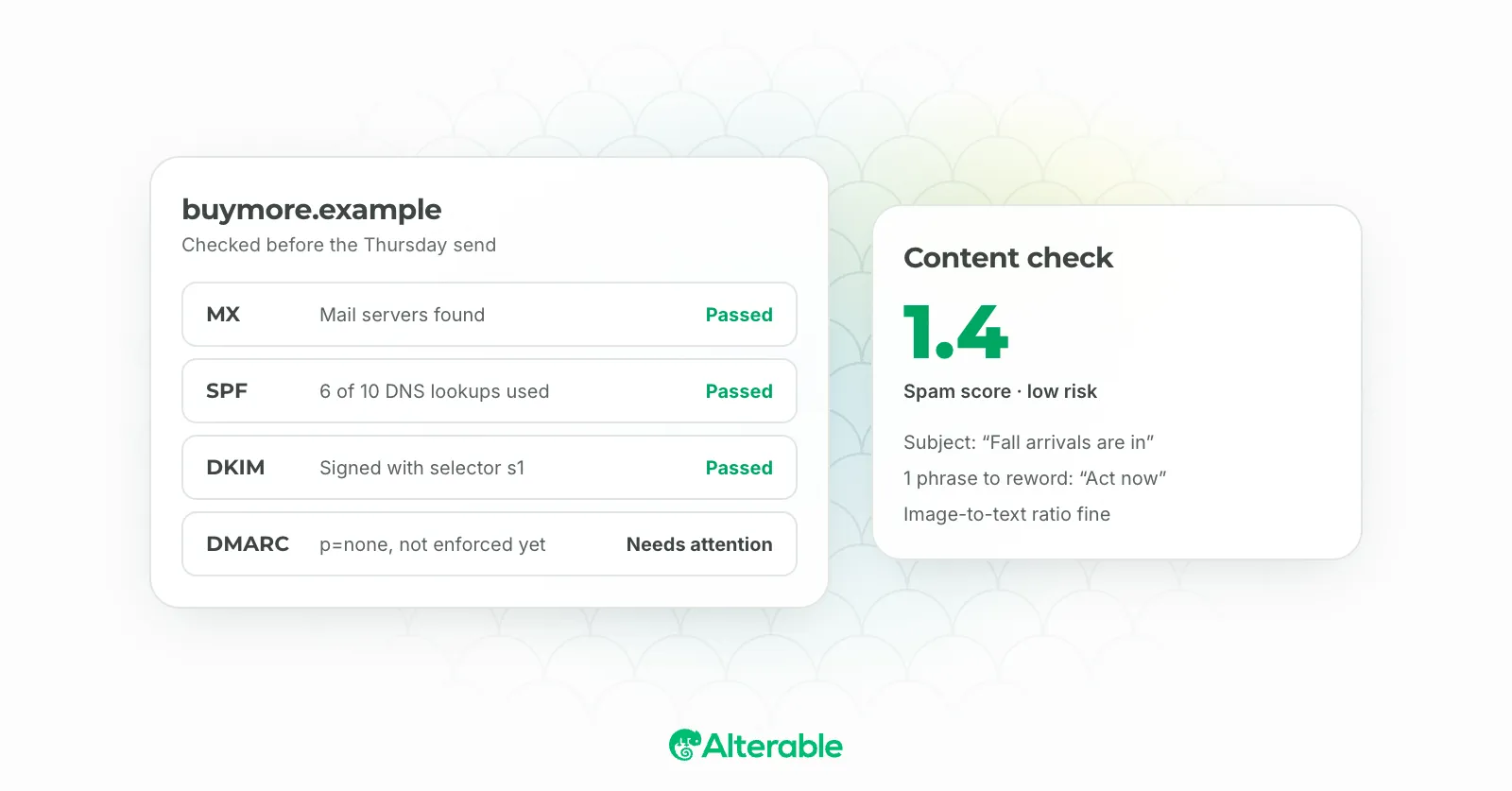
A lot of senders have SPF and DKIM set up but never move their DMARC policy off p=none. That means authentication failures are being reported but not acted on. For Gmail, moving to at least p=quarantine signals that you’re serious about controlling what goes out under your domain.
If you want to check what’s currently published in your DNS, our free email deliverability test verifies your SPF, DKIM, and DMARC in one pass; MXToolbox and DMARC Analyzer are useful for digging into individual records.
Diagnosing What’s Actually Wrong
Once Postmaster Tools is set up and authentication is in order, you can start reading the signals properly.
Domain Reputation below High? That’s the headline problem. The reputation dashboards don’t tell you exactly why you’re rated where you are, but you can triangulate from the other data. High spam rates and low engagement together usually mean you’re mailing people who don’t want your emails. Low domain reputation alongside clean spam rates might point to a volume problem: sending too much too fast, especially from a domain without much history.
Delivery errors showing up? Look at the error codes. 421 and 550 errors from Gmail often indicate reputation issues at the IP or domain level. 550 5.7.1 specifically means Gmail rejected the message outright, which is usually a reputation or authentication failure.
Spam rate climbing? This is almost always a list quality issue. Either you’re sending to people who never opted in clearly, you’re mailing too frequently, or your content has stopped being relevant to a segment of your list. Re-engagement campaigns and list pruning are the right tools here, not content tweaks.
One thing I’ve noticed: senders often focus on fixing deliverability after they’ve already got a bad reputation rating. That’s the hard path. The easier path is to catch the warning signs early (a Spam Rate nudging toward 0.08%, a Domain Reputation that slips from High to Medium) and act before Google starts throttling or rejecting.
Warm Up Your Sending Domain Properly
If you’re dealing with a Low or Bad reputation rating, or if you’ve recently migrated to a new domain, a warmup is often the right move. You can’t just send more emails and hope the reputation recovers by brute force.
To warm up your sending domain, start by dramatically reducing your volume and sending only to your most engaged subscribers: people who’ve opened or clicked in the last 30 to 60 days. Let that run for a week or two while you watch the Postmaster Tools signals. If your spam rate stays low and engagement is healthy, you can start expanding volume gradually.
The logic here is that Gmail builds a picture of who you are as a sender based on the ratio of engaged recipients to total recipients. Sending to a small, highly engaged group first improves that ratio and starts rebuilding trust. Sending to your full disengaged list just reinforces the pattern that hurt you.
A few things that help the warmup process work faster:
- Set up a sunset policy. Remove subscribers who haven’t opened in 180 days before you start the ramp-up. They’re not helping you.
- Watch complaint sources. If certain list segments are generating most of your complaints, identify them and exclude them early.
- Send consistently. Irregular sending patterns (nothing for a month, then a big blast) look suspicious. Steady cadence is better.
Warming up a domain isn’t glamorous. It feels like going backwards. But I’ve seen senders cut volume in half for three weeks and come out the other side with a High reputation rating and noticeably better open rates.
The Engagement Loop: What Gmail Actually Rewards
Authentication and warmup get you to a baseline. What keeps your Gmail reputation strong over time is subscriber engagement, because that’s what tells Google your emails are wanted.
Gmail pays attention to positive signals (opens, clicks, replies, moving mail out of spam, adding to contacts) and negative ones (marking as spam, deleting without opening, unsubscribing). The ratio matters.
Practically, this means a few things:
Keep your list clean. Run re-engagement campaigns for anyone who hasn’t opened in 90 to 180 days. A simple two-step sequence (one “are you still interested?” email, then a final notice before suppression) is enough. The goal isn’t to win everyone back. It’s to let the disengaged leave cleanly before they drag your metrics down.
Send content that earns the open. Subject lines that oversell and underdeliver train subscribers to ignore you, or worse, mark you as spam. Subject lines that are specific, relevant, and honest build the habit of opening. That sounds obvious, but I’ve seen a lot of senders sacrifice long-term trust for a short-term open rate bump.
Personalize based on behavior. The more relevant your content is to each subscriber at the moment they read it, the better your engagement signals will be. That means using behavioral data: what they’ve bought, what they’ve browsed, where they are in your customer lifecycle. Real-time personalization at the moment of open is even better, because it accounts for the fact that context changes between send time and read time.
At Alterable, that’s exactly what we help email teams do. Dynamic content that renders based on who’s opening and when they’re opening means you’re always showing the most relevant version of an email, which feeds directly back into the engagement signals Gmail uses to score you.
Fitting Gmail into Your Broader Sender Reputation Strategy
One thing worth saying clearly: your Gmail reputation is one piece of a broader sender reputation strategy. The practices that improve your standing with Google (authentication, engagement, list hygiene, consistent sending) are the same ones that improve your reputation with Yahoo, Outlook, and every other inbox provider.
That means you shouldn’t optimize narrowly for Gmail and ignore the others. Monitor your performance by domain. Set up Yahoo’s Complaint Feedback Loop and Microsoft’s SNDS alongside Postmaster Tools. If you’re seeing reputation problems at Gmail, there’s a reasonable chance the same root cause is affecting your deliverability elsewhere.
The broader point is that deliverability isn’t a one-time fix. It’s a discipline. The senders I’ve seen consistently land in the inbox aren’t doing anything exotic. They authenticate correctly, send to people who want their emails, and pay attention to the signals the providers give them.
Get those fundamentals right, and Gmail will generally reward you for it.