Most email engagement advice looks the same. Personalize your subject lines. Send at the right time. Clean your list. A/B test your CTAs. These aren’t wrong, exactly. But they’re so generic that following them faithfully can leave you with a technically optimized email program that still feels flat.
I’ve watched teams spend months tightening subject line formulas and fiddling with send times while the underlying problem, that they were sending the same content to everyone, went untouched. The surface-level tactics improved their metrics by a few percentage points. Fixing the actual problem moved them significantly.
So rather than another list of ten things, here’s what actually moves email engagement in my experience: the stuff that isn’t obvious, the stuff that gets overlooked, and a few popular tactics worth being skeptical about.
Relevance does more work than copy
This is the one I come back to most. The single highest-leverage thing you can do for email engagement isn’t a better subject line. It’s sending more relevant content to more specific audiences.
Think about it from your own inbox. If you get an email that’s genuinely about something you care about right now, you open it, even if the subject line is ordinary. If you get an email about something irrelevant, no amount of urgency language or emoji will make you click.
Segmentation used to mean splitting your list by broad demographics: age, location, job title. That’s a start, but behavioral segmentation is where the real gains are. Who bought what, when. Who clicked which category. Who’s visited a product page three times without purchasing. The more specifically you can match content to demonstrated interest, the less hard you have to work on every other variable.
I’ve noticed that teams often treat segmentation as a setup task, something you do once and then move on. In practice it’s ongoing. Subscriber interests shift, behavior patterns change, and segments that were meaningful six months ago may need rethinking. The engagement gains compound when you keep refining.
Your list size is probably working against you
More subscribers sounds like a good problem to have. Sometimes it is. But I’ve seen senders with lists of 200,000 who would get dramatically better results by sending to their 40,000 most engaged subscribers.
Here’s why. Mailbox providers like Gmail and Outlook watch how recipients interact with your emails. High open and click rates signal that your mail is wanted. Low engagement, especially across a large portion of your list, drags down your sender reputation with those providers, which means even your engaged subscribers see worse inbox placement over time.
The counterintuitive move is to suppress low-engagement subscribers from your main campaigns. Not forever, and not without trying to re-engage them first. But protecting your sending reputation by mailing less means your emails to engaged subscribers perform better. You get more from a smaller, healthier list than from a bloated one.
Send cadence matters more than send time
There’s been a lot of research published about optimal email send times. Tuesday at 10am. Thursday morning. Mid-afternoon. I’ve tried most of them. The truth is that optimal send time varies significantly by industry, audience, and the individual subscriber’s habits.
What matters more consistently is cadence: sending at a predictable rhythm that subscribers can orient around. A weekly newsletter that arrives every Thursday at 9am trains its audience to expect it. That expectation is a form of engagement before the email even opens.
Inconsistent sending, a burst of emails during a sale, then silence for three weeks, keeps subscribers perpetually uncertain about what they’re getting and when. That uncertainty shows up in your engagement numbers.
If you’re going to test send times, test them. But don’t treat a published benchmark as a substitute for understanding your actual audience.
Most re-engagement campaigns are too late
Re-engagement campaigns are standard advice: if a subscriber hasn’t opened in six months, send them a “We miss you” email with a special offer. Sometimes this works. More often, I think it’s closing the barn door after the horse has already left.
By the time someone has been disengaged for six months, the odds of winning them back are low, and the act of emailing them again can actually increase spam complaints if they’ve forgotten who you are. The more valuable intervention is earlier: noticing the drop in engagement at the 60 or 90-day mark and adjusting what you’re sending before the subscriber fully checks out.
That might mean moving them to a lower-frequency segment, shifting them to a different content track, or sending a single preference check that asks what they actually want to hear about. None of this is as satisfying as a “We miss you” email, but it preserves more subscribers over time.
Dynamic content changes the engagement equation
Most of the tactics above are about who you send to and when. Dynamic content changes what they see, and it’s one of the clearest ways to close the gap between what you can segment for at send time and what’s actually relevant when someone opens your email.
An email sent Monday morning can show different content depending on whether it’s opened immediately, two hours later, or three days later. A product recommendation block can pull from browsing history. A countdown timer shows the actual time remaining rather than a static deadline. Location-based content serves different offers to subscribers in different cities.
The key word is relevant. Dynamic content isn’t impressive because it’s technically interesting. It’s valuable because relevance drives engagement, and relevance at open time is more precise than relevance at send time.
A note on the metrics
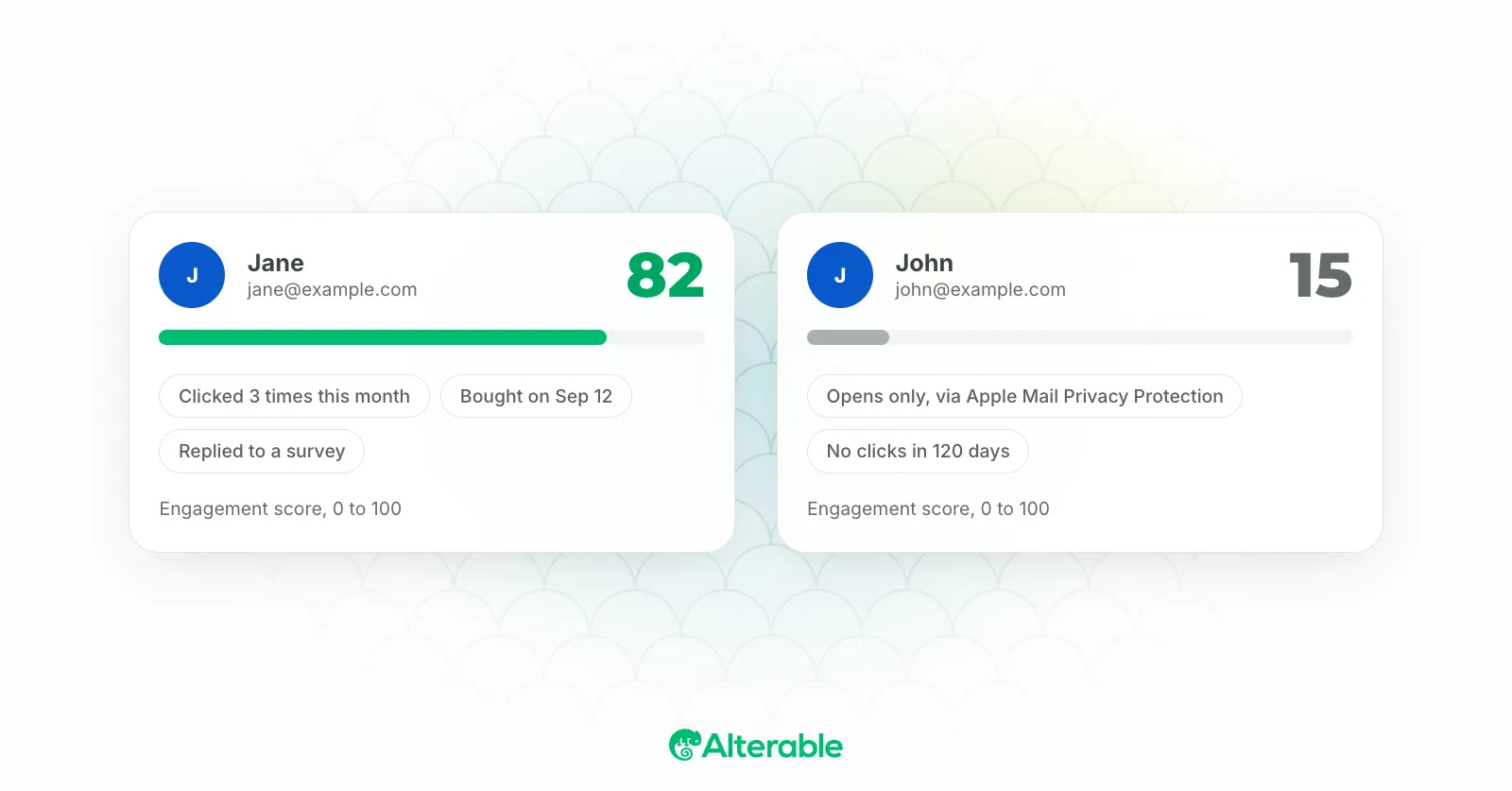
One thing worth acknowledging: email engagement as a measurement has gotten complicated. Apple’s Mail Privacy Protection, introduced in 2021, pre-loads email pixels for many Apple Mail users, meaning an “open” from those subscribers may be an automated proxy request, not an actual human opening the email. Our post on this covers the implications in more detail.
The practical consequence is that click rate has become a more reliable engagement signal than open rate for many senders. Clicks require intent. If you’re optimizing for engagement, make sure you’re watching the metrics that still reflect real behavior.
Engagement isn’t a mystery. It’s the output of sending relevant content to the right people at a sustainable pace, and having the infrastructure to make that relevance more precise over time. The tools that help you do that, from dynamic content to proper segmentation, are more accessible than they’ve ever been. The work is mostly in deciding to prioritize them.