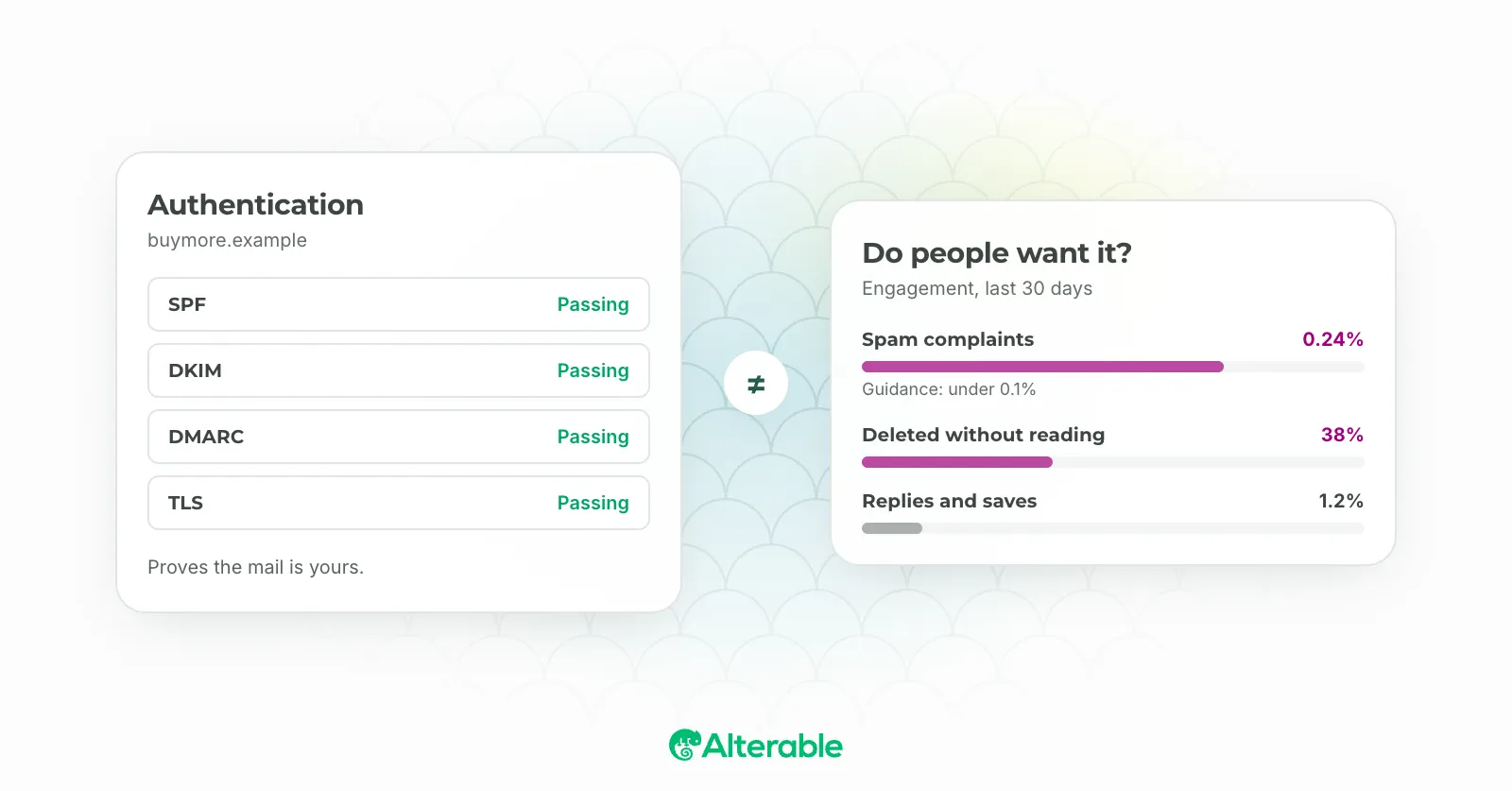
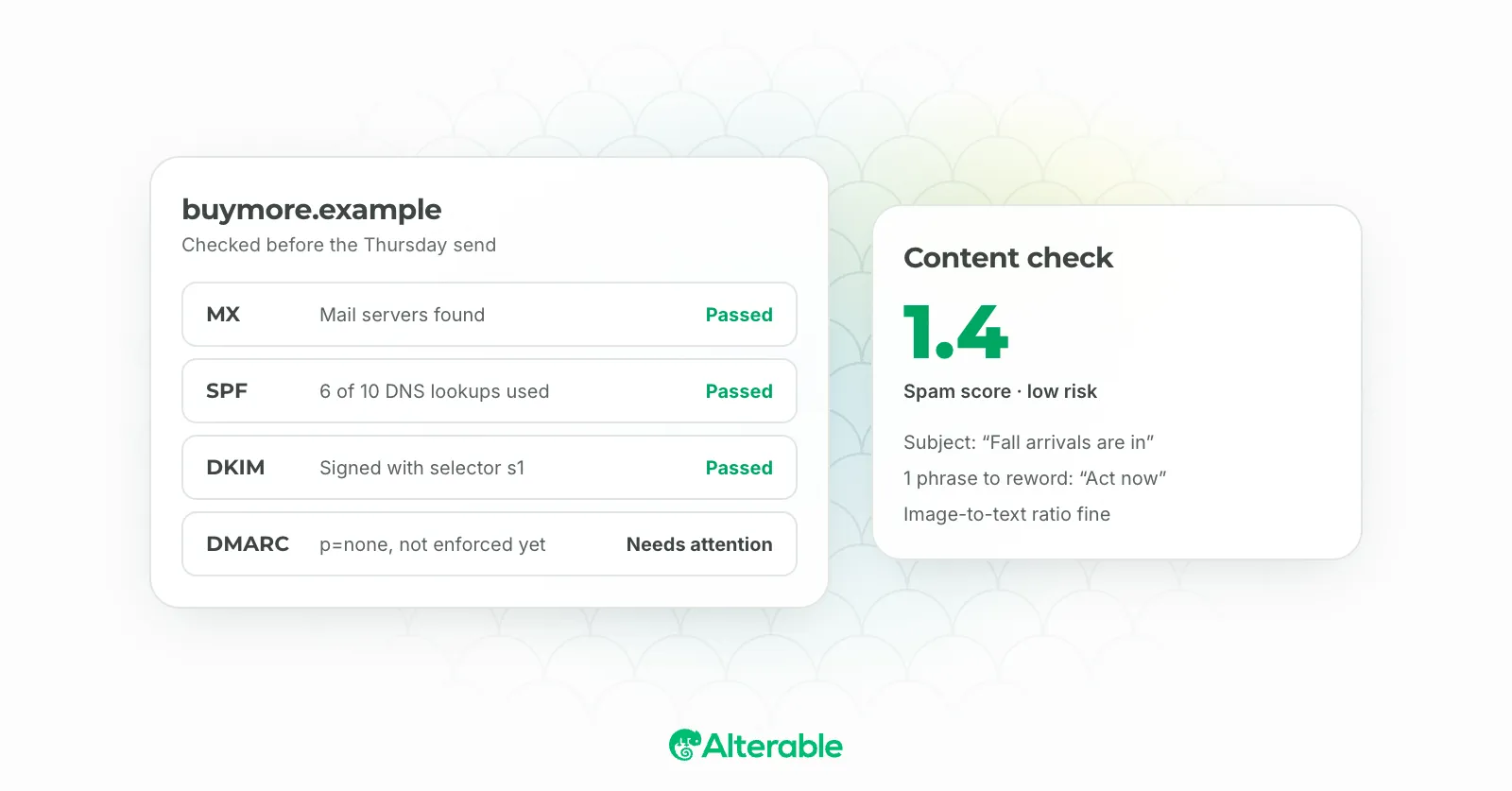
I’ve seen email programs fall apart not because of bad content or poor strategy, but because of list hygiene. A sender who’s been getting solid results starts seeing open rates drop, bounce rates creep up, and then one day their emails start landing in spam. By the time the problem is visible, the damage to their sender reputation is already done.
Most of the time, the fix started with email list validation. It’s not glamorous, but it’s foundational.
What Email List Validation Actually Does
Email list validation is the process of verifying that the addresses on your list are real, active, and worth sending to. A good validation service runs each address through several checks in sequence.
Syntax and format verification comes first. Does the address look like a valid email address? A missing ”@”, a misspelled domain, an extra space: these are easy to introduce during data collection and easy to catch with validation.
Domain verification confirms that the domain itself is active and has a functioning mail server. An address can be syntactically correct but attached to a domain that no longer exists. That’s a hard bounce waiting to happen.
Mailbox verification goes deeper. This step checks whether the specific mailbox exists and can receive mail, by pinging the mail server without actually sending anything. Think of it as the difference between confirming the building exists and confirming the specific apartment is occupied.
Spam trap detection is where things get more consequential. Spam traps are addresses used by ISPs and blacklist operators to catch senders with poor list hygiene. There are two main types: pristine traps (addresses that have never opted into anything, so if you’re emailing them, you acquired them improperly) and recycled traps (old addresses that were once valid but have been repurposed to catch senders who don’t clean their lists). Hitting spam traps can get your IP blacklisted. Good validation services flag them before you send.
Role-based address detection identifies addresses like info@, support@, or hello@ that are managed by teams rather than individuals. These tend to have lower engagement rates and higher complaint rates, making them risky to include in marketing sends.
Disposable address detection catches temporary addresses that users create to get access to something without giving a real email. They’re usually short-lived, and building a list full of them is building on sand.
Why It Matters More Than Most People Realize
The obvious benefit is deliverability. A high bounce rate signals to mailbox providers that your list is poorly maintained, which damages your sender reputation and eventually affects where your emails land. Keeping your hard bounce rate under 2% isn’t a suggestion. It’s a baseline requirement for maintaining inbox placement.
But there’s a less obvious benefit worth knowing about: protection against list bombing.
List bombing is an attack where someone floods your sign-up form with fake, malicious, or third-party email addresses in rapid succession. Sometimes it’s a competitor trying to damage your sender reputation. Sometimes it’s your email address being used to sign up for services without your knowledge. Either way, you end up with a list full of addresses that bounce, complain, or belong to people who have no idea who you are.
Real-time validation at the point of sign-up catches this before it enters your list. After-the-fact bulk validation catches what slipped through. Both have a role.
There’s also the straightforward efficiency argument. Sending to invalid addresses costs you money (most ESPs charge by volume), wastes your sending infrastructure, and drags down every metric you care about. Cleaning your list improves your numbers not by improving your emails, but by removing the dead weight that was suppressing them.
What to Look For in a Validation Service
The core capabilities (syntax, domain, mailbox, spam trap, disposable detection) are table stakes. Beyond that, a few things worth evaluating:
Deliverability guarantee. Some providers guarantee a deliverability rate on addresses that pass their validation. It’s a meaningful signal of confidence in their accuracy.
Real-time API access. If you want to validate at the point of sign-up rather than in bulk after the fact, you need a service with a real-time API you can connect to your forms. Not all of them offer this cleanly.
Output clarity. For cleaning existing lists, how a service categorizes its results (valid, invalid, risky, unknown) affects how easy it is to act on the findings. A result that just says “undeliverable” is less useful than one that tells you why.
Recommended Providers
I’ve worked with a few of these over the years, and Kickbox is the one I keep coming back to. This isn’t a paid recommendation. It’s just the tool that has consistently given us the most reliable results. Their database is extensive, their categorization is clear, and they back their results with a 95% deliverability guarantee.
Their case study with Rocksbox, a subscription jewelry service, shows what validation can actually move:
- 27% decrease in hard bounce rate across all sends
- 10% improvement in open rates across their welcome series
- 42% increase in click-through rate
- Average open rates of 25-30% month-over-month
Those aren’t marketing improvements. They’re the result of removing addresses that were quietly dragging every metric down.
Other providers worth knowing about:
- ZeroBounce: Strong on spam trap and abuse address detection. Also offers email scoring alongside validation, which is useful for prioritizing your most engaged contacts.
- NeverBounce: Good real-time verification and list cleaning. Solid if you need both bulk processing and API access.
- Hunter: Better known as a prospecting tool, but their email verifier is reliable for smaller lists and one-off checks.
- BriteVerify: One of the older players in the space. Dependable for bulk validation and integrates with most major ESPs.
- Experte: A free option for one-off verification with no account required. Useful for quick spot checks before a send.
Email list validation is one of those things that feels like maintenance until you see what happens when you skip it. A clean list doesn’t just protect your sender reputation. It means every open rate, click rate, and conversion figure you’re looking at is actually telling you something real, rather than being diluted by addresses that were never going to engage.