A few years ago, I watched a European fashion retailer send the same summer sale email to their entire global list. Bikinis and sundresses are landing in inboxes across Scandinavia, Southeast Asia, and South America, all at the same time, with the same imagery, the same copy, and the same currency. The results were predictable: open rates were fine in a couple of markets, dismal in most others. The unsubscribe spike in regions where it was literally winter told the whole story.
That experience stuck with me because it illustrates something most email marketers already sense but haven’t fully acted on: localized content in emails isn’t a nice-to-have anymore. It’s the difference between an email that feels like it was written for the reader and one that clearly wasn’t.
Here are seven reasons why localized email content drives measurably higher engagement, each backed by real-world results.
1. Localized emails earn dramatically higher open and click rates
Let’s start with the numbers. Personalized emails see 29% higher open rates and 41% higher click-through rates compared to non-personalized emails. And when that personalization includes location-specific elements (local imagery, regional offers, nearby store details), those numbers climb further.
I’ve seen this play out firsthand with ecommerce brands that simply swapped generic hero images for location-relevant ones. One change, one variable. Personalization based on location can boost conversions by up to 27%. That’s not a marginal lift. That’s the kind of improvement that makes a quarterly target.
Why does it work? Because when someone in Portland opens an email and sees a rainy-day outfit recommendation, it doesn’t feel like marketing. It feels like relevance.
2. Speaking your subscriber’s language changes everything
This one sounds obvious, but the data behind it is staggering. CSA Research surveyed 8,709 consumers across 29 countries and found that 76% prefer to buy products with information in their native language, and 40% flat-out refuse to purchase when the content isn’t in their language. Even more telling: 56.2% of consumers say content in their language matters more to them than a lower price.
500px, the photography platform, saw this firsthand. When they used Braze’s language targeting to send promotional emails in German and French to their respective audiences, revenue in Germany surged by 257%. France saw a 145% increase. Germany went from a minor market to one of their top three within months.
The takeaway isn’t just “translate your emails.” It’s that localized content in the subscriber’s language signals respect. It tells them you see them as more than a row in a spreadsheet. And respect converts.
3. Weather-based targeting makes your content feel uncannily relevant
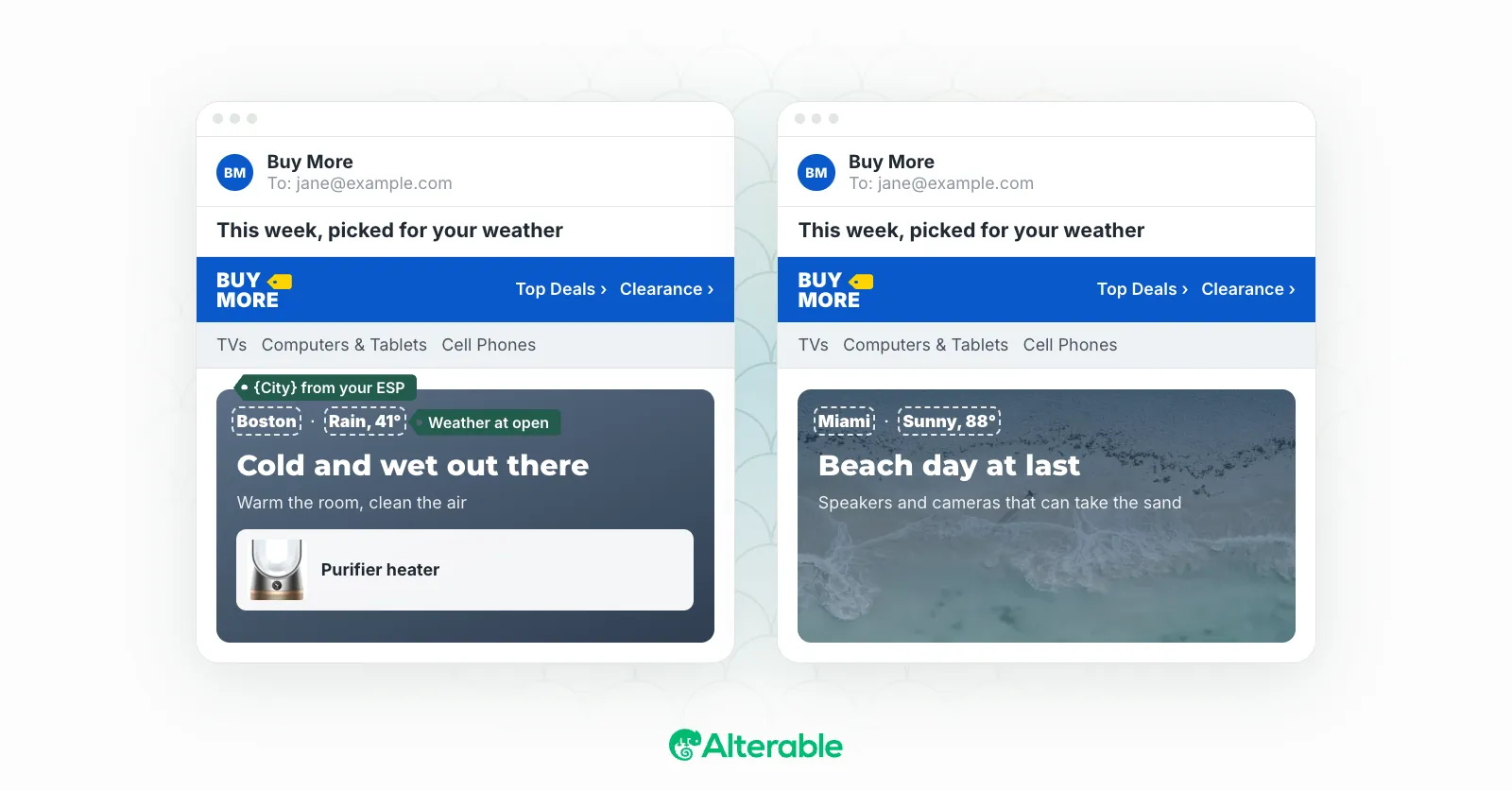
Here’s where localized content gets interesting. Weather-based personalization uses a subscriber’s geolocation to serve products and messaging that match their current conditions. It sounds like a gimmick until you see the results.
UK grocery chain Asda populates emails with localized weather data and promotes products accordingly: barbecue supplies and cold drinks when the sun is out, comfort food and warm clothing when temperatures drop. Argos takes a similar approach, targeting subscribers in areas expecting freezing conditions with battery chargers, hot flasks, and windshield protectors.
The performance impact? Weather-targeted campaigns can increase click-through rates by 39%, and one study showed open rates climbing by 500% for domestic holiday campaigns sent during favorable weather, with CTR jumping from 12% to 27%.
I’ve noticed that weather-based personalization works especially well because it taps into something the subscriber is already experiencing. You’re not predicting their needs based on past behavior. You’re matching their present reality. That’s a fundamentally different kind of relevance.
4. Regional send-time optimization is the easiest win you’re probably ignoring
You can have the best localized content in the world, but if it lands in someone’s inbox at 3 AM, it’s buried by morning. Region-based send windows alone can lift open rates by 12–15%, which makes timezone segmentation one of the highest-ROI changes a global team can make.
Many teams now use staggered rollouts to avoid midday troughs in regions where mobile engagement drops around lunchtime. It’s not glamorous work. It won’t make a case study headline. But it’s the kind of operational discipline that compounds over every single send.
How many of your campaigns right now go out at one time to your entire list? If the answer is “most of them,” you’re leaving engagement on the table before subscribers even see your content.
5. Location-specific offers drive real-world action
Localized email content doesn’t just improve digital metrics. It drives feet through doors. Starbucks sends location-based promotions about nearby offers and store events, making each email feel less like a broadcast and more like a heads-up from a friend who knows your neighborhood.
Sephora takes a more creative approach. They use geofencing at airports to send push notifications after a user clears security, asking if they need to replace any confiscated beauty products and pointing them to a nearby store. The result: a 20% increase in airport store visits. The messaging perfectly matches the subscriber’s current situation and real-time needs.
And then there’s Burger King’s famous Whopper Detour campaign, which geofenced 14,000 McDonald’s locations to offer a one-cent Whopper when users came within 600 feet. The result: 1.5 million app downloads in nine days and a 37:1 return on investment. While that’s a mobile app example, the principle translates directly to email. When the offer is tied to where someone actually is, it stops being theoretical.

6. Localization goes beyond translation (and that’s where the real lift lives)
I’ve seen brands translate their emails word-for-word into six languages and wonder why engagement didn’t improve. The problem is almost always the same: translation without adaptation.
True localization means adjusting cultural references, imagery, humor, pricing formats, and even color choices. A promotional email that works perfectly in the US with red “SALE” banners might need an entirely different visual treatment for a Japanese audience, where red carries different associations and aggressive discounting can feel off-putting.
The results speak for themselves: Coca-Cola’s partnership with Adobe Experience Cloud enabled over 350 personalized email journeys across more than 100 countries, achieving an average open rate of 40% and a 63% uplift in click-through rates. That wasn’t a translation project. It was a cultural adaptation project.
This is the part most marketers skip. They invest in the translation layer but stop short of the cultural layer. And the cultural layer is where trust gets built.
7. Real-time localization at open makes every email feel current
Here’s what ties everything together. The most effective localized content isn’t set at send time. It’s rendered at open time.
Think about it: a subscriber might receive your email in the morning but not open it until evening. Their weather has changed. A nearby store might have different inventory. A local event might have sold out. If your content was locked in at send time, it’s already stale by the time they read it.
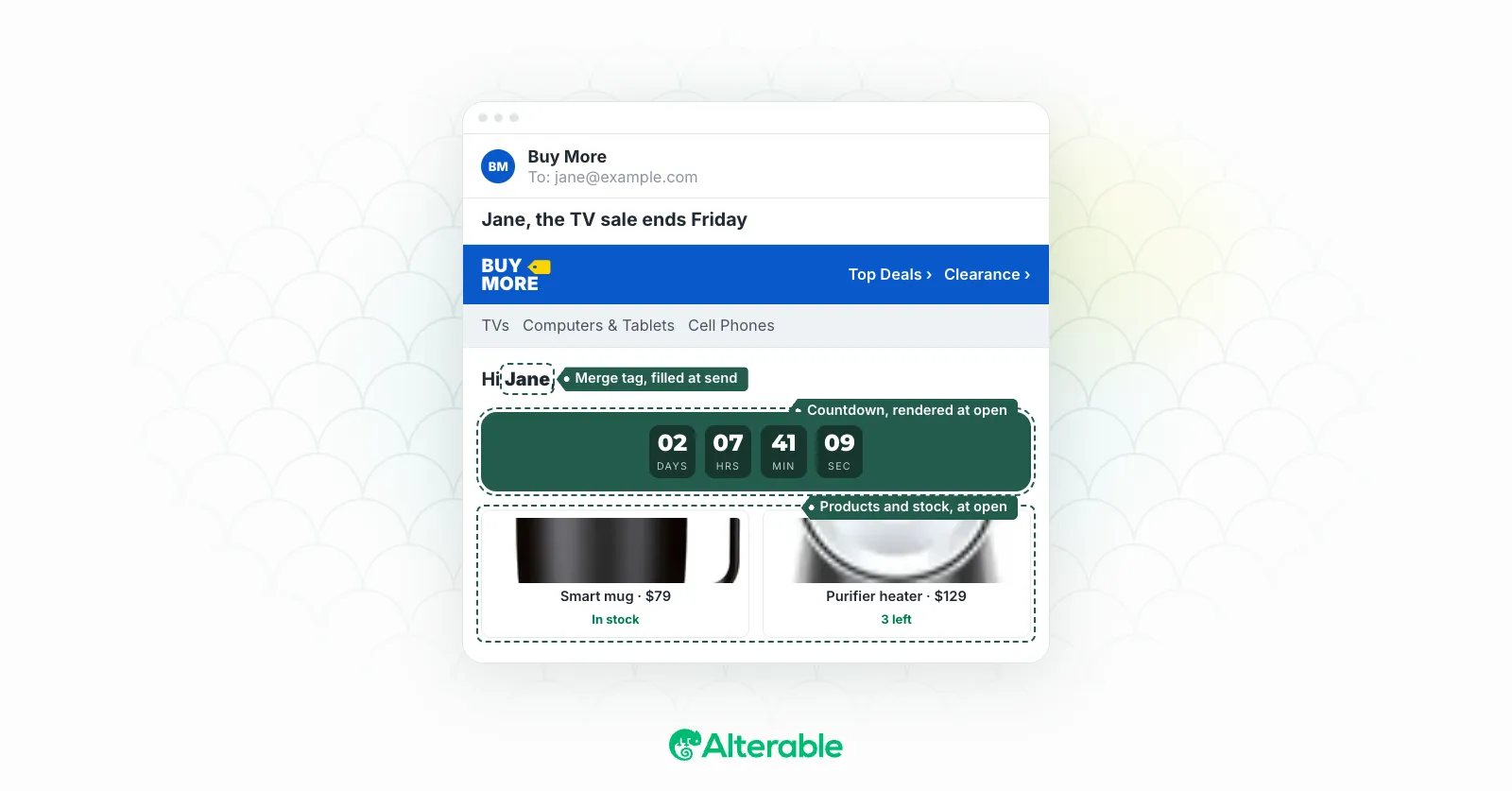
Real-time rendering at the moment of open means the email can pull in current weather data, live store availability, countdown timers that actually reflect the subscriber’s timezone, and location-specific imagery that matches where they are right now (not where they were six hours ago).
This is exactly the kind of problem Alterable was built to solve. By rendering personalized, location-aware content at the moment each subscriber opens the email, you don’t have to guess what will be relevant. You just let the data do the work in real time.
Localized email content works because it closes the gap between what subscribers expect and what most brands actually deliver. The data is clear: higher open rates, higher click-through rates, higher conversion rates, lower unsubscribe rates. Every metric that matters moves in the right direction when content feels like it was made for the person reading it.
You don’t need to localize everything overnight. Start with timezone segmentation. Add location-based imagery. Test weather-driven product recommendations in one campaign. The lift will make the case for going further.