

Think back to what email “personalization” used to mean. You dropped a subscriber’s first name into the subject line, pushed send to your entire list, and called it done. The results were fine. Not transformative, just fine. And for a while, the bar was low enough that fine was good enough.
Those days are gone. Not because the technology changed overnight, but because your subscribers did. Amazon, Netflix, and Spotify have spent years conditioning people to expect content that feels like it was made specifically for them. That conditioning doesn’t turn off when someone opens their inbox. Which means if you’re still running batch-and-blast campaigns in 2026, you’re not competing on a level playing field. You’re playing a different game entirely.
The successful email campaigns worth studying right now share a common thread: they go well beyond first names and basic segmentation. I’ve spent a lot of time looking at real examples (sites like Email Love, which catalogs campaigns from 6,000+ brands, are genuinely useful for this), and the gap between forgettable and remarkable almost always comes down to two things: personalization that draws on actual behavioral data and dynamic content that adapts to the subscriber’s context rather than the sender’s send schedule.
The “Hello, First Name” Era Is Behind Us
Let’s be honest about merge tags. They still work a little. Personalized subject lines still outperform generic ones in open rates. But they’re table stakes now, not a differentiator. According to Litmus’ 2026 State of Email report, 97% of marketers already use at least one interactive or personalized element in their emails. If your definition of personalization stops at %%first_name%%, you’re in a shrinking minority, and your subscribers can feel it.
What the best marketers understand is that personalization isn’t a feature you add to an email. It’s the organizing logic of the entire campaign. The question isn’t, “How do I make this email feel more personal?” It’s “What does this specific subscriber need from me right now, and how do I make sure that’s exactly what they see?”
That’s a harder question. It’s also a more interesting one.
What Dynamic Content Actually Looks Like When It’s Done Well
One of the best real-world examples I’ve come across is how Ted Baker handles product recommendations. Rather than hard-coding product images at send time, they pull live data into each email, featuring their most viewed and purchased products from the past seven days and updating them based on the moment the subscriber actually opens the email. If you open it three days after it landed in your inbox, you see current inventory and current pricing, not products that may have sold out before you clicked. Their CRM layers on top of that, filtering recommendations to match each subscriber’s preferred categories.
The result: an email that’s relevant at open, not just at send. That’s a meaningful distinction.
Kate Spade takes a different angle. Instead of using a subscriber’s name in the subject line (though they do that too), they embed it directly into the hero image itself, using personalized imagery. It’s a small touch that changes the experience considerably. The email looks handcrafted, which makes it feel worth reading.
Boux Avenue automated a campaign built entirely around time-of-open personalization. They serve up content that displays the current zodiac sign at the moment the subscriber opens the email. No manual segmentation, no complex workflow. One automated campaign, perpetually current. It’s a clever use of a simple mechanic.
These aren’t brands with unlimited engineering resources. They’re doing this with tools that are broadly accessible. The difference is intention and a willingness to think past the send button.
The Strategy Underneath the Personalization
Here’s what’s easy to miss when looking at personalization examples: the dynamic content itself is often the simpler part. What’s harder, and what the best marketers consistently get right, is the data foundation underneath it.
Segmentation is the entry point. Litmus found that more than 90% of marketers who use segmentation report improved email performance. That tracks. But the interesting shift isn’t whether you segment; it’s how granularly you do it. The most effective teams have moved from broad demographic buckets (“women, 25-35”) toward micro-segments built around behavior and lifecycle stage: “browsed this category twice in the past 14 days, loyalty tier Silver, never purchased.”
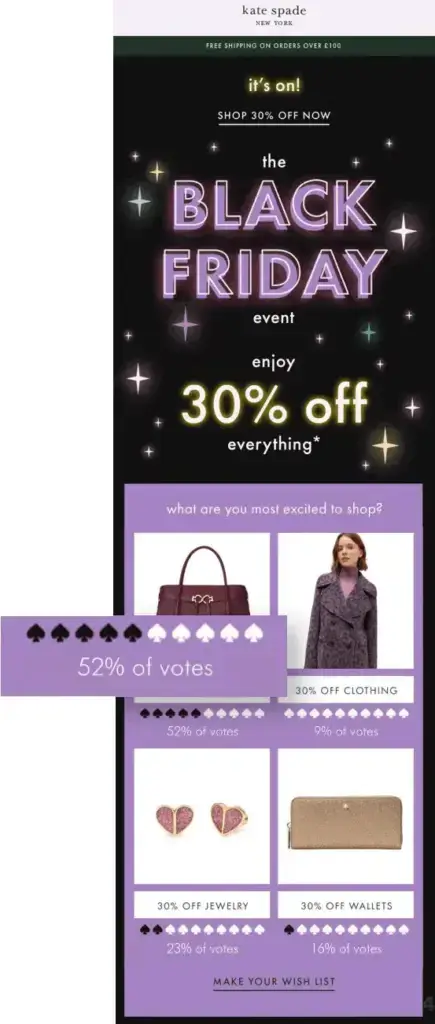
Kate Spade illustrates this particularly well. They ran a campaign where subscribers voted for their favorite product style via a live poll embedded directly in the email. Each vote counted as a click. 24 hours later, a segmented follow-up went out: voters got personalized recommendations tied to their chosen style, and non-voters got best-sellers. Elegant because it creates value for the subscriber and data for the brand simultaneously.
Mamas and Papas applied similar thinking to life cycle stages. Their emails to expecting parents are personalized around the subscriber’s current pregnancy week, with content and product suggestions that shift as the pregnancy progresses. They layer in real Instagram content, too, building community and social proof in the same send. You’re not just getting an email; you’re getting a resource that makes sense for where you are right now.
This is the part most marketers skip. Not the technology. The intentionality is about what the subscriber actually needs at this specific moment in their journey.
The Role of Real-Time in Successful Email Campaigns
Real-time email content is where things get genuinely interesting. Not “real-time” in the sense of a fast send time. Real-time as in the email renders differently depending on when, where, and on what device the subscriber opens it.
I’ve noticed that even marketers who understand dynamic content still tend to think about it as a send-time decision. “What content should I put in this email?” But the more powerful question is: “What content should this subscriber see when they open this, regardless of when that is?”
Those are different questions with different implications.
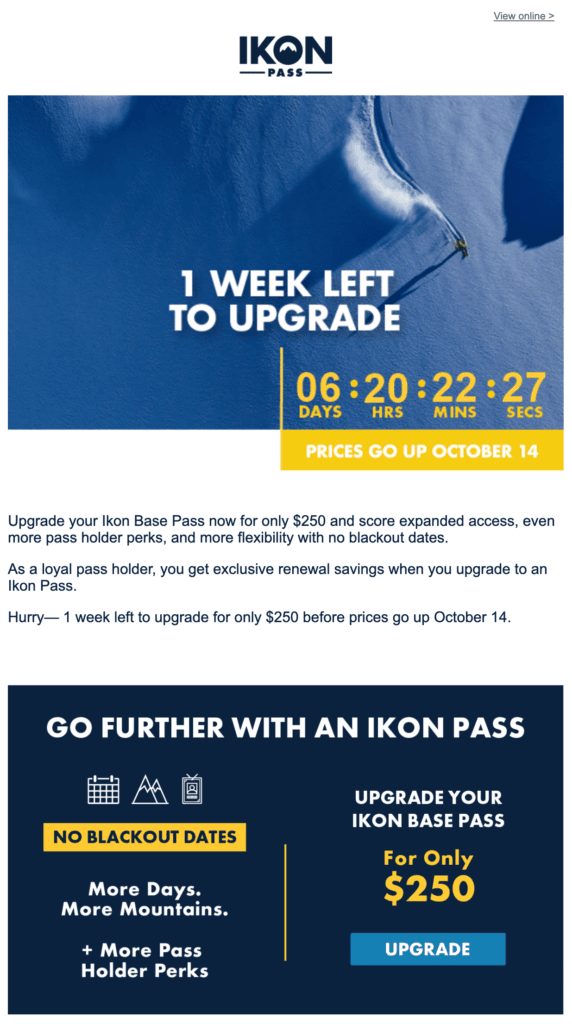
Countdown timers are a simple example of real-time done right. Ikon Pass embeds a live timer in their email header showing time remaining on promotional pricing. Open the email the day it arrives, see one number. Open it two days later, see a different one. The urgency is genuine because it’s calculated from the moment of opening, not from the send timestamp. iClothing applies the same approach during Black Friday, with lightning deal sections in their emails that mirror what’s live on their website at that moment. The email becomes a live window into the site.
The effect: relevance that doesn’t decay. An email worth opening even if it sat unread in someone’s inbox for three days.
According to industry data, real-time personalization delivers 20% higher conversion rates compared to standard personalization approaches. Companies that do it well see up to 40% revenue increases compared to competitors. Those numbers aren’t surprising once you understand the mechanic: you’re removing the staleness problem entirely.
Behavioral Triggers: Getting to the Right Subscriber at the Right Moment
Personalization and dynamic content are most powerful when they’re layered onto behavioral triggers. Not “we send every Tuesday at 10am” but “we send this email when a subscriber has looked at this product category twice in 7 days and hasn’t purchased.”
41% of consumers are most likely to open an email when it includes an offer connected to something they’ve already engaged with. Which means the most valuable email you can send often isn’t your most polished newsletter. It’s the one that arrives at the exact right moment in the subscriber’s own journey.
Airbnb is a well-worn example here, but worth mentioning because they do it so cleanly: if you’ve been searching for accommodations in Lisbon, their emails featuring Lisbon experiences feel useful rather than promotional. Domino’s uses purchase history to trigger loyalty reward reminders, which land because they’re relevant to what the customer already wants. Netflix has essentially organized their entire email program around behavioral personalization.
How many of the emails sitting in your inbox right now feel like they were timed to a moment in your life, not just to a marketer’s send calendar? Those are the ones worth reverse-engineering.
Your ESP almost certainly has behavioral triggering capability built in. The question is whether you’ve mapped out the moments in the subscriber journey that actually warrant a send, and built automations around those moments rather than around a weekly broadcast schedule.
First-Party Data: The Foundation Everything Else Depends On
Here’s something I’ve seen trip up more than a few email teams: they invest in personalization technology and then realize they don’t have the subscriber data to run it well. A sophisticated dynamic content template powered by an empty recommendation engine is just a complicated empty email.
With third-party cookies largely gone, the data you collect directly from subscribers (preference centers, live polls, surveys, and behavioral tracking) becomes the backbone of your entire personalization strategy.
Hunter’s approach is worth borrowing. They embedded a live poll in an email asking subscribers to choose their favorite boot style. That poll functions simultaneously as an engagement driver (each vote is a click), a first-party data collection mechanism, and a content hook that makes the email worth interacting with. 65% of email marketers now cite dynamic content as their most effective personalization tactic, but dynamic content needs data to be dynamic against. Hunter’s figured out how to collect that data in the same moment they deliver value.
The brands running the most successful email campaigns have built systematic ways to collect and use subscriber preference data. Not in a heavy-handed “fill out this survey” way, but embedded into experiences that subscribers actually want to engage with.
Putting It Together
If I were looking at my own email program and thinking about where to start, I’d approach it in layers.
The first layer is segmentation, which is not complex but meaningful. Lifecycle stage, engagement level, and product category interest. If you’re sending the same email to everyone on your list regardless of where they are in their relationship with you, that’s the first problem to solve.
The second layer is dynamic content, building templates that adapt rather than managing multiple versions of them. Products, images, copy, offers: all of it can vary based on who opens the email and when. This is also where real-time data becomes useful. If your email pulls in current product availability or pricing at open time, you never risk sending outdated information to someone who finally gets around to clicking three days later.
The third layer is behavioral triggers. Map out the moments in the subscriber journey that actually warrant an email, then automate around those moments. A subscriber who just browsed your most expensive product twice and hasn’t bought deserves a different email than someone who bought last week.
The fourth layer is first-party data collection. Build it into every campaign. Live polls, preference centers, post-purchase surveys: each touchpoint is a chance to learn something that makes the next email better.
If you’re curious about what real-time personalization looks like at the implementation level, specifically the mechanics of email content that renders differently based on when and where subscribers open it, that’s exactly what we built Alterable to handle. Worth exploring if you’re at that stage.


